

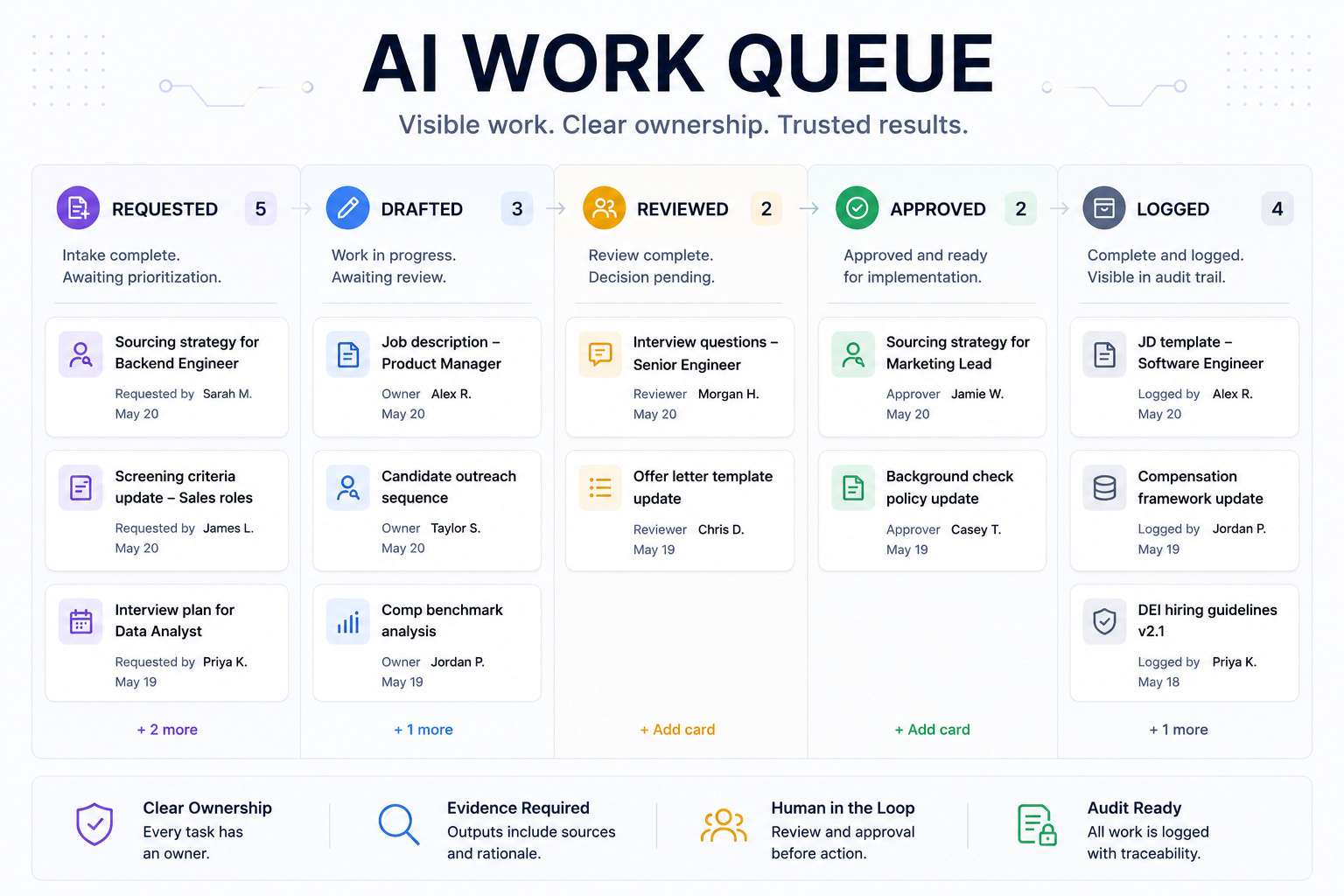
Last year, many recruiting teams were asking:
“Can AI do this task?”
This year, the question is different:
“Can we trust it to do this task repeatedly?”
That’s a harder problem.
An AI-generated candidate summary can sound polished while containing unsupported claims. An interview-prep brief can look useful while pulling from outdated notes. A sourcing workflow can save hours while quietly introducing errors nobody notices until weeks later.
The challenge is proving that the output is grounded, reviewable, auditable, and safe. Evidence is becoming more important than capability.
The most important AI news this week was about evaluation, governance, retention, observability, and security. The operating layer is catching up to the model layer.
Evidence is becoming more important than capability.
2-Minute Skim
3 things to know
AI evaluation is becoming a discipline. Teams are moving beyond “looks good to me” and measuring traces, source grounding, tool usage, and failure modes.
AI governance is moving into enterprise workflows. Retention policies, legal holds, auditability, and usage reporting are becoming standard expectations.
AI has become a security attack surface. Recruiters are increasingly exposed to fake AI tools, malicious browser extensions, and AI-themed phishing campaigns.
2 things to test
Build a 20-case evaluation set for one recruiting workflow.
Verify whether AI-generated recruiting content is retained, discoverable, and governed by existing company policies.
1 thing to ignore
“End-to-end recruiting agents” that cannot explain where information came from, what tools were used, what actions were blocked, or what human review occurred.
The Shift This Week
Many teams evaluate AI by looking at the final answer, which can be a mistake.
A candidate summary can be well written and still be wrong. A hiring-manager update can be concise and still omit important information. A sourcing assistant can generate outreach that sounds great while referencing facts that don’t exist. The output is only the artifact.
The question should be: How did the AI get there?
That’s why several major announcements this week all pointed in the same direction: The future of enterprise AI is better evidence.
1. AWS Is Making AI Evaluation Practical
AWS released Agent EvalKit, an open framework for systematically evaluating AI agents and workflows. Instead of only judging outputs, teams can evaluate:
Tool usage
Traces
Source grounding
Faithfulness
Failure modes
Workflow improvements
Recruiting implication
Most recruiting teams don’t need agent evaluations. They need workflow evaluations.
Start with a single use case:
Candidate summaries
Hiring-manager updates
Interview preparation packets
Pipeline health reports
Then test it against messy real-world scenarios:
Missing information
Conflicting information
Outdated information
Sensitive information
Unsupported requests
Takeaway
A polished hallucination is more dangerous than an obviously bad answer because people trust it.
Related: In If You Cannot Audit AI Hiring, Do Not Scale It, I explored why explainability and traceability need to come before AI scale.
2. AI Conversations Are Becoming Business Records
Google announced support for retention rules and legal holds for Gemini conversations through Vault. This sounds like a compliance feature, but it’s actually a recruiting governance feature.
Many recruiting teams are already using AI to:
Draft candidate summaries
Prepare interview packets
Create outreach messages
Generate hiring-manager updates
Those outputs often become part of the hiring process.
Recruiting implication
Ask a question:
If legal asked for every AI-generated artifact involved in a hiring decision, could you produce it?
Many organizations can’t answer that confidently.
Takeaway
If candidate-related AI work exists, retention policies should exist too.
Related: AI Recruiting Needs Permission — because governance doesn’t start with prompts. It starts with records, approvals, and accountability.
3. AI Hype Has Become a Security Risk
Microsoft published new research showing attackers using fake AI products, cloned websites, malicious browser extensions, and fraudulent GitHub repositories to distribute malware and steal credentials.
Recruiting implication
Recruiters are becoming prime targets because they routinely:
Open attachments
Review resumes
Install productivity tools
Connect ATS integrations
Work across multiple systems
One unapproved browser extension can create significant risk.
Takeaway
The riskiest AI tool in your organization may be the one somebody found in a LinkedIn comment.
4. OpenAI Is Shifting Toward Workflow Training
OpenAI launched new workplace-focused learning programs through OpenAI Academy. The interesting part is what the training emphasizes:
Context
Review
Repeatability
Oversight
Workflow design
Not prompt tricks, prompt engineering hacks, or magical templates.
Recruiting implication
Teaching recruiters prompts isn’t enough.
Teach:
Workflow boundaries
Evidence requirements
Review standards
Escalation paths
Quality checks
Takeaway
Prompt training without operating standards creates inconsistency.
5. Persistent Agents Are Coming
OpenAI announced plans to acquire Ona, a company focused on secure, persistent execution environments for AI agents.
Whether you use OpenAI products or not, AI is moving from individual conversations toward long-running systems that operate inside controlled environments.
Recruiting implication
The future recruiting agent is a system that:
Maintains reports
Checks data quality
Monitors workflows
Flags exceptions
Updates documentation
And does it continuously.
Takeaway
Persistent agents require persistent controls. They’re systems, not assistants.
Recruiting Playbook
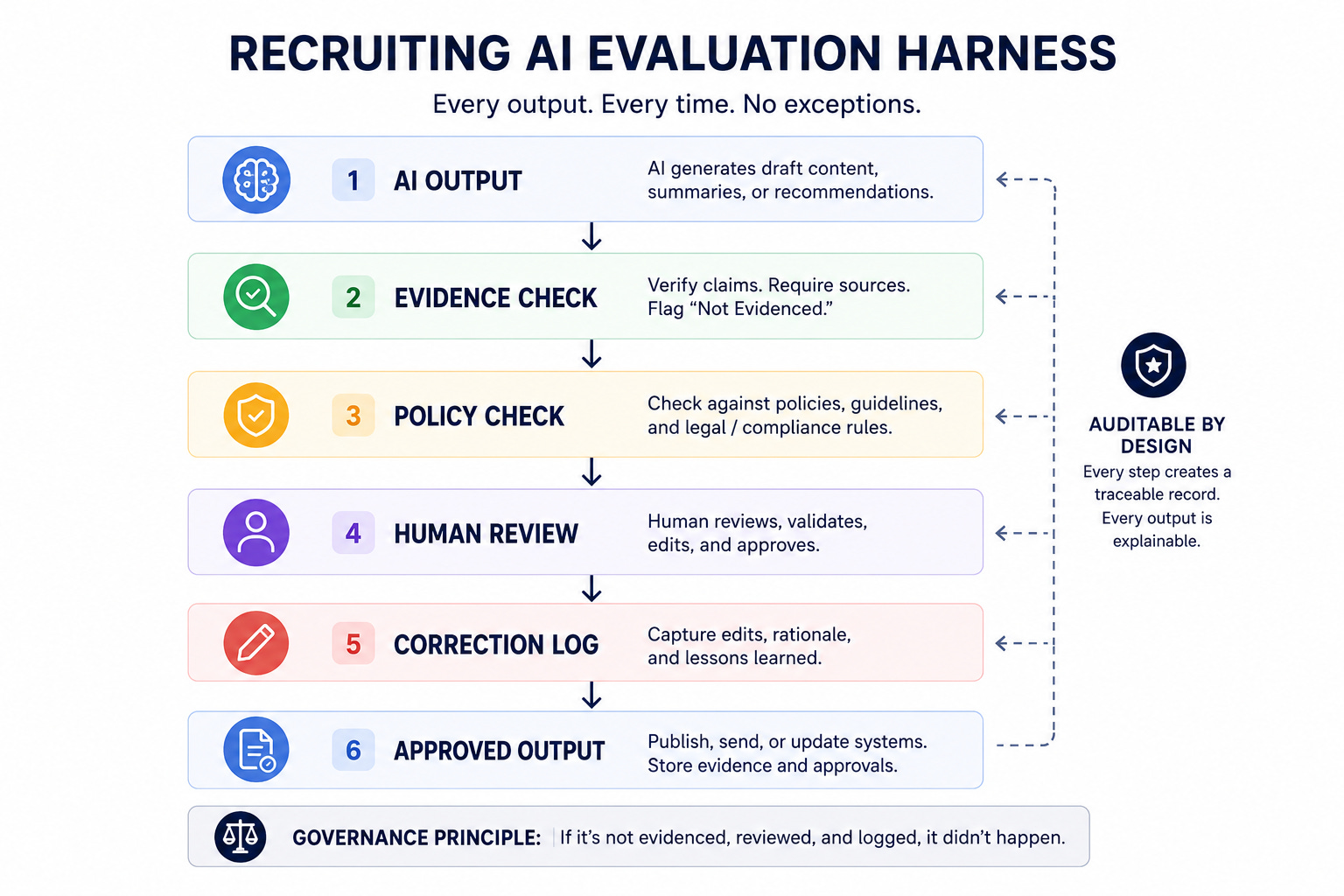
Build a Recruiting AI Evaluation Harness
Before expanding any AI workflow that touches:
Candidate summaries
Interview preparation
Outreach drafting
ATS notes
Hiring-manager updates
Pipeline reporting
Run this process.
Step 1: Pick one workflow
Examples:
Candidate summary
Interview prep packet
Hiring-manager update
Step 2: Create 20 evaluation cases
Include:
Normal cases
Missing-information cases
Conflicting-information cases
Outdated-information cases
Sensitive-data cases
Step 3: Define blocked actions
Examples:
Ranking candidates
Recommending rejection
Inferring protected traits
Changing ATS stages
Sending messages
Compensation recommendations
Step 4: Require evidence
Every factual claim must trace back to source material.
Missing information should be labeled:
Not Evidenced
Step 5: Measure corrections
Track:
Unsupported claims
Missing evidence
Policy violations
Reviewer corrections
Time saved
Step 6: Run the same test again
If performance improves, you’re learning.
If performance varies significantly, you’re not ready for production.
Fast Wins This Week
Build a 20-case evaluation set for one recruiting workflow.
Add “Not Evidenced” as required language whenever source material is missing.
Review retention policies for AI-generated recruiting content.
Audit recruiter browser extensions and AI tools.
Start tracking correction rates on AI-assisted work.
What I’m Watching
The hype around AI recruiting is centered on capabilities, but I’m paying attention to control.
Who can access the system? What evidence supports the output? What actions are blocked? What gets logged? What gets retained? What gets reviewed?
Those questions aren’t as exciting as new models, but that’s where recruiting is headed next.
Question for readers
If your recruiting team had to audit every AI-generated hiring artifact created in the last 90 days, could you explain:
where the information came from,
who reviewed it,
what changes were made,
and whether it was retained?
Reply and let me know how your team is approaching AI governance today.
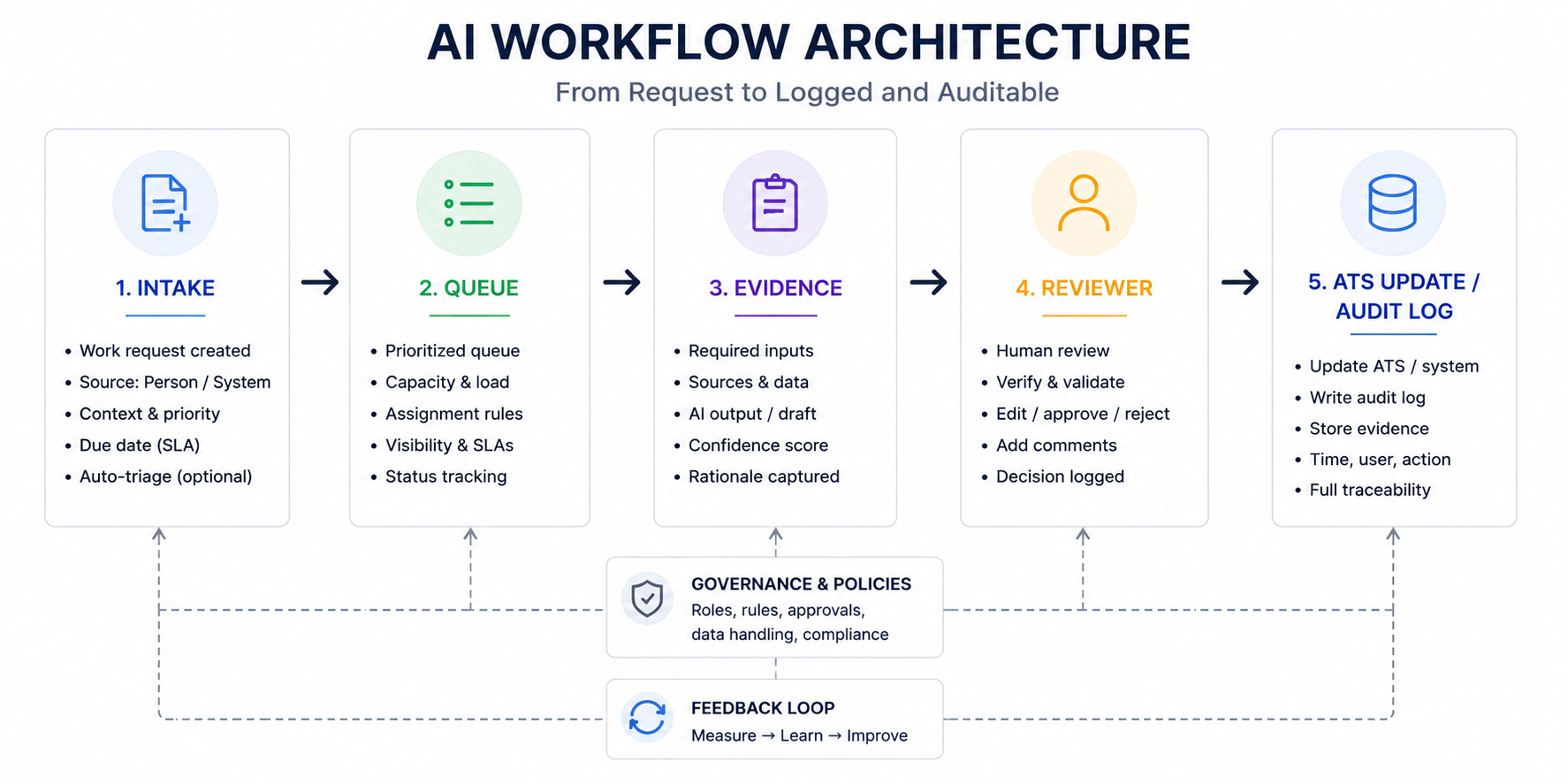
The teams that move fastest won’t necessarily win. The teams that can prove what happened will. Every recruiting AI workflow will eventually need:
traceability
approval logic
evidence standards
permission controls
human accountability
If your team is experimenting with recruiting agents, workflow automation, or AI routing systems, reply with the biggest AI governance or workflow challenge you’re trying to solve. I may feature the best examples in a future issue.