

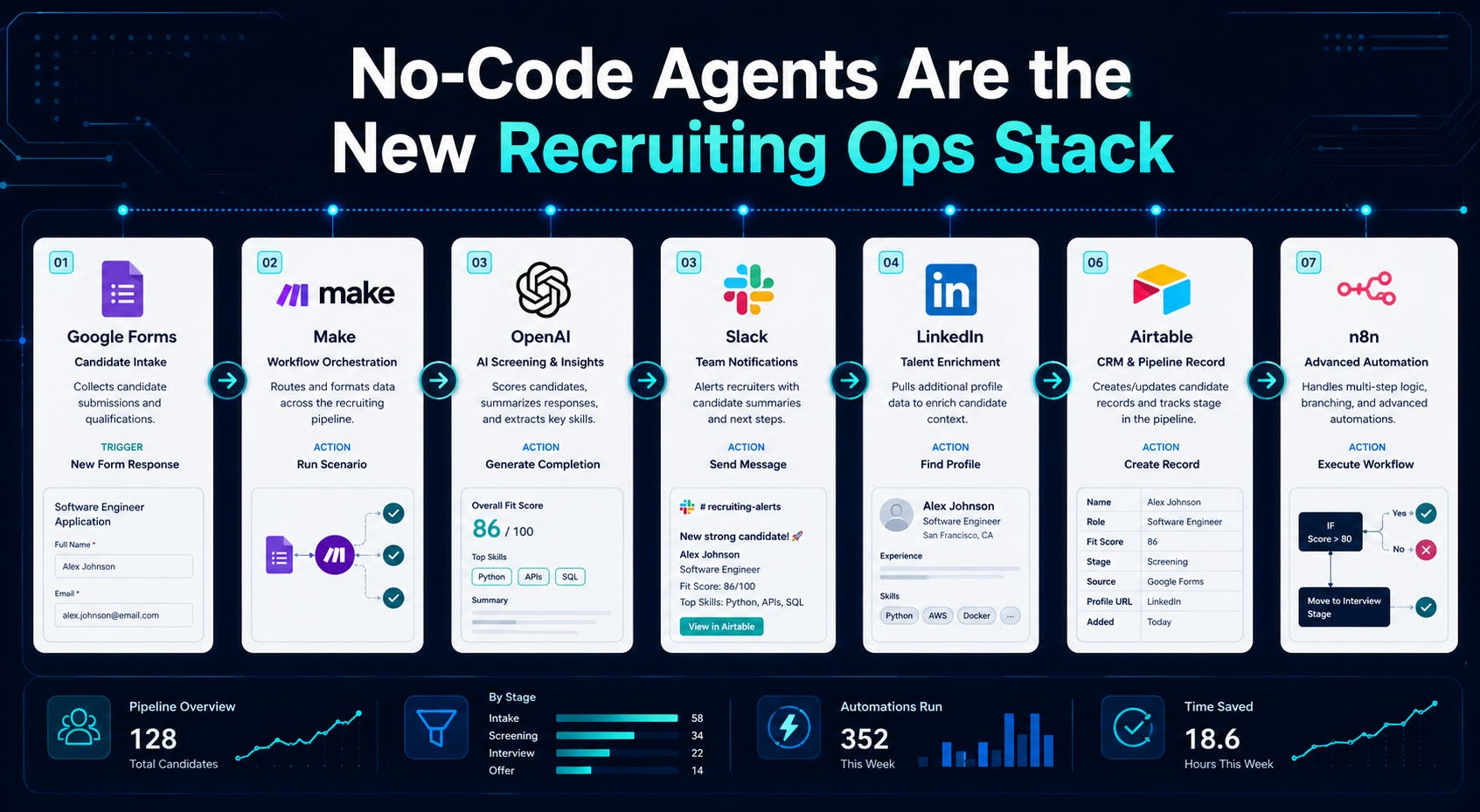
Recruiting operations is becoming a workflow engineering function.
The biggest shift in recruiting AI is that non-technical teams can now build production-ready workflows using tools like Make, n8n, LinkedIn integrations, and lightweight agents.
The barrier to entry for automation is gone. That creates leverage - and operational risk.
2-Minute Skim
3 Things to Know
Make users are publishing copy-paste recruiting agents that parse, score, and route resumes in seconds using Google Forms, Sheets, Slack, and Gmail.
n8n shipped 15 instant-import AI agent templates that can run self-hosted with no cloud lock-in.
LinkedIn’s 2026 Hiring Release makes AI targeting and ATS-connected evaluation default workflow features.
2 Things to Test
Deploy a resume-screening workflow for one high-volume role with explicit confidence thresholds and recruiter review gates.
Build a candidate FAQ assistant using n8n and your existing careers-page content.
1 Thing to Ignore
Vendor claims about massive efficiency gains without independent validation. The workflows are real. The specific percentage is not verified.
Executive Brief
This was a low-signal week for product launches and a high-value week for execution.
Make, n8n, and the emerging “trigger → parse → score → route” pattern are turning integration platforms into recruiting operations infrastructure.
The gap between: “AI recruiting” and “AI recruiting I can actually operationalize” is closing.
You no longer need:
engineering resources
procurement cycles
custom APIs
enterprise implementation projects
to automate:
screening
candidate routing
recruiter support
FAQ workflows
onboarding coordination
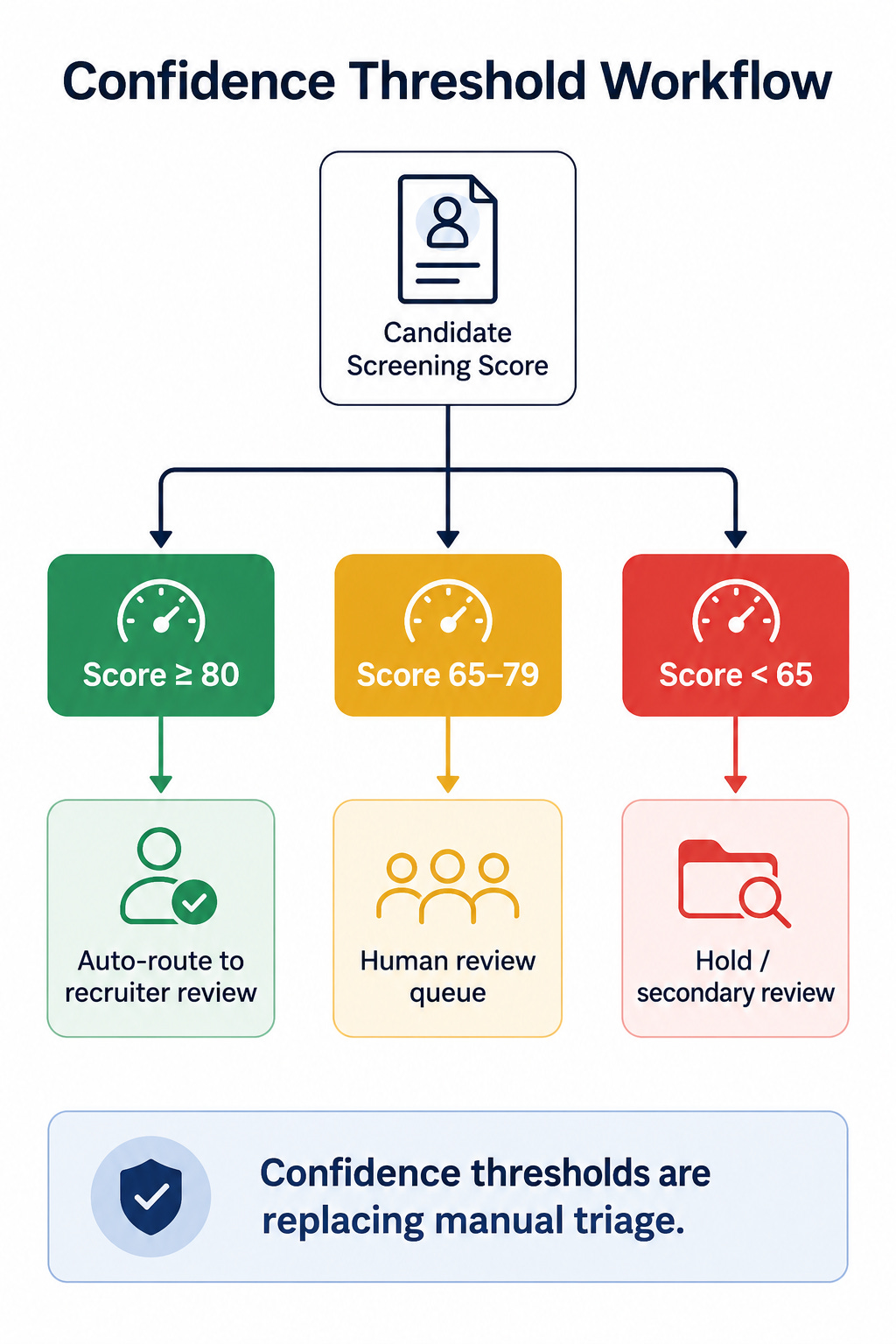
Confidence thresholds are becoming the default human-in-the-loop mechanism.
Related: I recently wrote about why recruiting AI systems need explicit approval logic, audit trails, and permission boundaries before they touch production workflows in “AI Recruiting Needs Permission.”
For recruiting leaders, the question is no longer: “Can AI help recruiting?”
The question is:
What actions are allowed?
What evidence supports them?
Where are the review gates?
Who owns the decision?
Can the workflow be audited later?
Operational Signals This Week
Make Published the Most Practical Recruiting AI Workflow So Far
A Make community workflow now:
accepts resumes through Google Forms
extracts candidate data with OpenAI
scores against a job description
routes high scorers to Slack
logs decisions in Sheets
sends candidate follow-ups automatically
All with no code.
Recruiting use case: Replace manual top-of-funnel review for high-volume roles.
👉 Takeaway: The important shift is that recruiting teams can now build production-ready workflows without engineering support.
Source: Make Community Build - “How We Built an AI Agent That Hires 5x Faster Using Make”
n8n Is Becoming the Best Privacy-First Recruiting Agent Framework
n8n shipped 15 importable AI agent templates that run locally or self-hosted through Docker.
That matters for:
GDPR-sensitive workflows
healthcare recruiting
candidate FAQ systems
internal knowledge retrieval
onboarding automation
Recruiting use case: Deploy a candidate FAQ assistant that never sends PII to third-party hosted AI systems.
👉 Takeaway: Self-hosted agent infrastructure is moving from developer-only territory into recruiting operations.
Source: n8n Blog - “15 Practical AI Agent Examples to Scale Your Business”
LinkedIn Made AI Workflow Defaults Mainstream
LinkedIn’s 2026 Hiring Release folds AI targeting, follow-ups, and ATS-connected evaluation into the standard recruiter workflow.
The biggest operational change:
ATS Connected Projects.
LinkedIn AI can now evaluate candidates who never touched LinkedIn directly.
Recruiting use case: Enable AI targeting and ATS-connected evaluation on one high-volume role.
👉 Takeaway: The distinction between sourcing systems and applicant systems is evolving.
Source: LinkedIn Talent Solutions - AI-Powered Applicant Targeting, Featured Jobs, ATS Connected Projects
Healthcare Credentialing is the Biggest Automation Opportunity
For healthcare recruiting teams, credentialing is still the largest operational bottleneck after offer acceptance.
The emerging workflow pattern is becoming standardized:
Portal
→ OCR extraction
→ Rules engine
→ API verification
→ Exception routing
Recruiting use case: Automate clinician onboarding workflows and reduce manual document coordination.
👉 Takeaway: Credentialing is becoming an orchestration problem, not just an administrative problem.
Source: Cypress Healthcare Consulting — automated provider onboarding
Playbook of the Week
Build a Permissioned Resume-Screening Workflow
The fastest way to test recruiting AI is structured evidence packaging with clear review ownership.
Workflow architecture
Candidate Intake
↓
Resume Parsing
↓
Structured Extraction
↓
Scoring Against Criteria
↓
Confidence Threshold
↓
Human Review Queue
↓
ATS / CRM Logging
↓
Audit Trail
Recommended Stack
Google Forms → candidate intake
Make or n8n → orchestration
OpenAI → extraction/scoring
Slack → recruiter routing
Google Sheets or Airtable → audit log
What To Automate
Allowed:
evidence extraction
structured summaries
missing-information detection
recruiter packet preparation
workflow routing
Blocked:
autonomous rejection
compensation recommendations
protected-trait inference
final ranking decisions
unsupervised ATS updates
What Good Looks Like
Every workflow has confidence thresholds
Every AI-generated claim has traceable evidence
Every routing decision is logged
Every automation has rollback paths
Recruiters review borderline outputs before action
The goal is to reduce low-value coordination work.
Prompt Chain of the Week
Run sourcing, outreach, screening, and evaluation support for one role using a single AI workflow.
Prompt 1 - Candidate Search
Generate a Boolean search string for:
LinkedIn
GitHub
Google X-Ray

based on:
[title]
[skills]
[location]
[seniority]
[remote requirements]

Return only the Boolean string.
Prompt 2 - Personalized Outreach
Write a recruiter outreach message under 100 words that:
references recent candidate work
explains relevance
avoids generic recruiting language
ends with a low-friction CTA
Prompt 3 - Structured Screening
Generate:
3 technical questions
2 behavioral questions
scoring criteria
follow-up probes

Use plain language and structured evaluation criteria.
Prompt 4 - Interview QA
Review interview notes and identify:
unsupported claims
vague feedback
missing evidence
recommendation drift
bias risk

Rewrite the evaluation into a structured hiring memo.
Tool / Capability Radar
TEST
Make + OpenAI Routing
High-leverage screening and workflow orchestration without engineering support.
Team-Level AI Metrics
Useful enablement signal. Weak productivity metric.
Candidate FAQ Agents
Strong ROI for repetitive recruiting questions.
WATCH
AI Interview Scoring
Validation and candidate trust still lag adoption.
Browser-Based Agents
Prompt injection risk is real.
Autonomous ATS Actions
High governance risk without approval logic.
ADOPT
Confidence Threshold Routing
This is becoming the default human-review mechanism.
State-Based Workflow Design
Recruiting agents need explicit workflow states:
waiting
approved
blocked
escalated
completed
Without state logic, agents invent progress.
Fast Wins
15 Minutes
Add a confidence threshold to one AI workflow.
20 Minutes
Create a blocked-actions policy for recruiting AI systems.
25 Minutes
Audit which AI tools currently touch:
ATS
HRIS
candidate files
email
calendar systems
30 Minutes
Deploy a Google Form resume intake workflow for one role.
45 Minutes
Run an AI workflow inventory:
tool
owner
data touched
decision influence
approval logic
auditability
Strategic Experiments
Permissioned Resume Routing
Hypothesis
AI can reduce recruiter review time without removing human ownership.
Measure
false positives
unsupported claims
recruiter satisfaction
candidate experience
time-to-review
Self-Hosted Recruiting Agents
Hypothesis
Privacy-sensitive workflows will increasingly move toward self-hosted orchestration.
Measure
implementation speed
governance overhead
maintenance complexity
operational flexibility
Confidence Threshold Hiring Models
Hypothesis
Confidence thresholds will replace manual triage queues.
Measure
recruiter review load
decision consistency
escalation frequency
quality-of-hire indicators
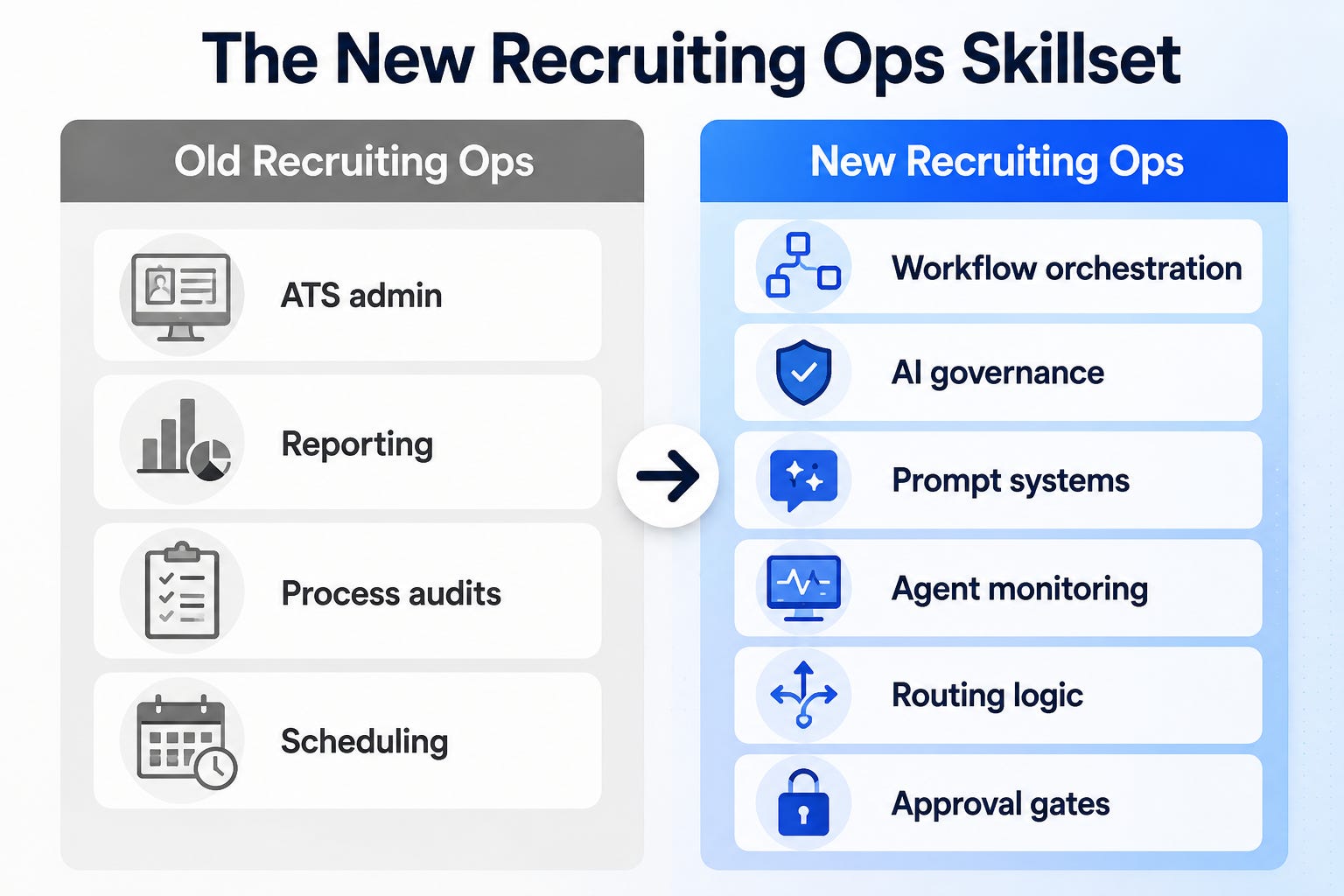
Every recruiting AI workflow will eventually need:
traceability
approval logic
evidence standards
permission controls
human accountability
The next generation of recruiting systems will not be defined by who adopts AI first.
They will be defined by who governs it best.
If your team is experimenting with recruiting agents, workflow automation, or AI routing systems, reply with the most useful workflow you’ve built - or the one you still cannot operationalize safely.