

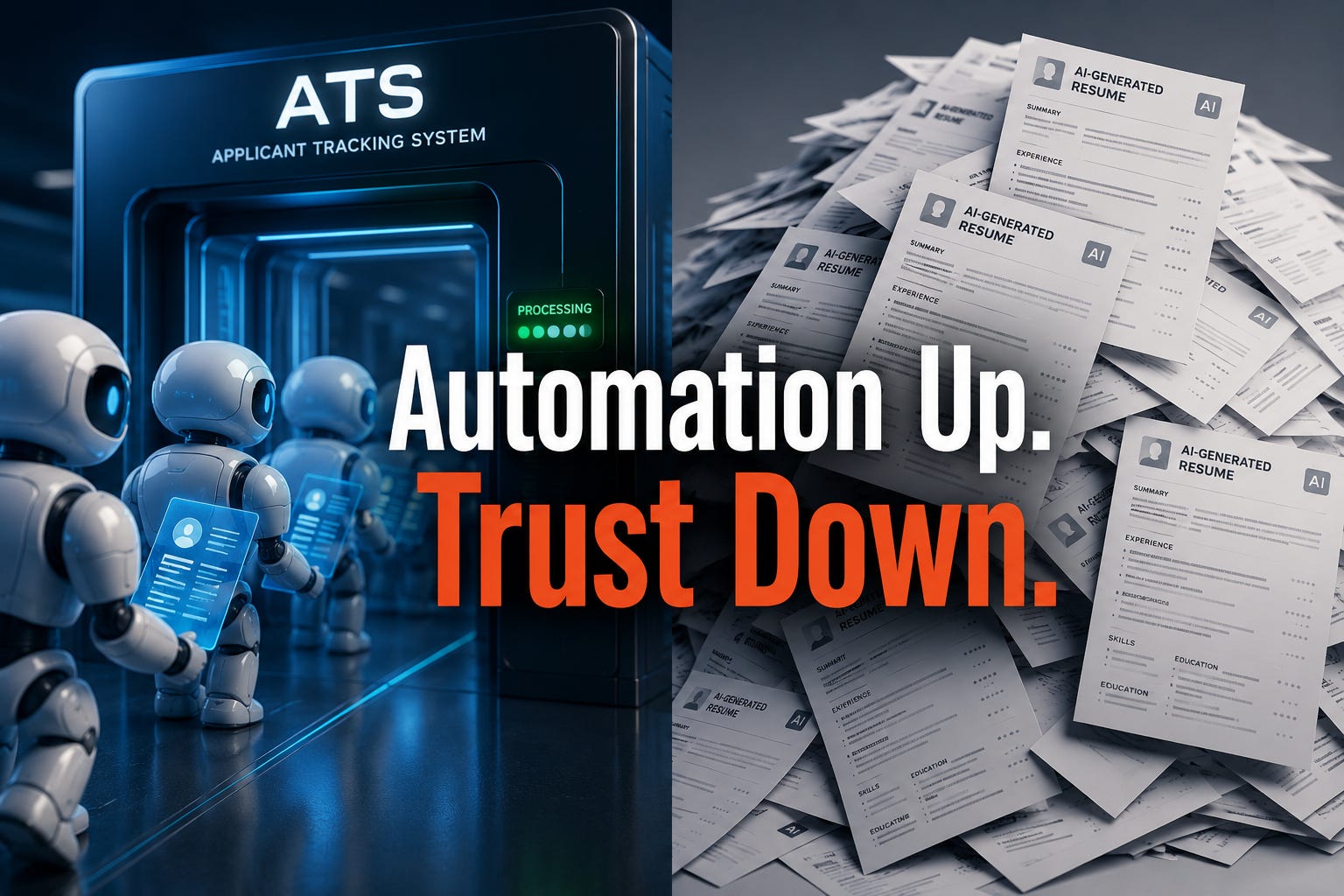
Recruiting teams are getting squeezed from both directions.
ATS vendors are adding autonomous agents that can source, screen, schedule, and communicate with candidates. At the same time, candidates are using AI to generate more applications, better resumes, and more polished narratives.
This creates a new recruiting operations challenge: How do you automate more while trusting less?
2-Minute Skim
3 Things to Know
ATS vendors are shipping agentic features: Ashby, SmartRecruiters, LinkedIn, Workday, Paradox, Yello, and iCIMS all advanced AI-driven recruiting workflows this month.
HR teams are reporting more AI-generated applications, more resume noise, and more pressure to verify candidate authenticity.
Recruiters need a tighter screening stack: red-flag prompts, structured evidence checks, identity verification, and manager-approved exception paths.
2 Things to Test
Add one evidence-based prompt to your application flow (“Describe one project, your exact contribution, the tools used, and the measurable result”).
Run the Resume Red-Flag Screener prompt chain on your last 10 screened resumes and compare human vs. AI flags.
1 Thing to Ignore
Generic vendor blog posts that describe “the future of AI recruiting” without product names or release dates. The ones below all have actual ships or hard data.
Executive Brief
More powerful AI assistants are entering hiring platforms at the same time AI-generated applications are flooding the top of funnel. Ashby announced AI Agents plus Assistant and MCP support; SmartRecruiters shipped Winston Companion, a compliance dashboard, and MFA; LinkedIn expanded Hiring Assistant and tied into Workday + Paradox; Yello launched an AI campus recruiting agent; and iCIMS framed the market as candidates outpacing employers in AI adoption.
At the same time, Robert Half reports 67% of HR leaders say AI-generated applications are slowing hiring. The takeaway is that recruiters need systems that do more than sort resumes. They need workflows that detect fabrication, preserve candidate experience, and maintain compliance without drowning teams in manual review. The winning play is simple: verify evidence, standardize screening, and use AI to triage noise while humans make the final judgment.
What Matters This Week
Ashby Ships Native AI Agents Inside the ATS
Ashby expanded its AI-native ATS with Agents, an AI Assistant, and MCP (Multi-Channel Publishing) support, meaning the ATS can now execute sourcing, screening, outreach, and scheduling tasks rather than only suggesting them.
Recruiting use case: A senior tech recruiter can define a requisition, and Ashby’s agents will autonomously surface candidates from competitive talent pools, sequence outreach across email, SMS, and LinkedIn, and auto-schedule interviews when response thresholds are met.
Takeaway: If you are on Ashby or evaluating ATS upgrades, “agentic” is now a required RFP category. Ask your vendor: which stages can the system execute versus only recommend?
Related: Agentic ATS workflows introduce the same governance challenges I covered in AI Recruiting Needs Permission.
67% of HR Leaders Say AI-Generated Apps Are Slowing Hiring
Robert Half’s 2026 survey of 1,500+ HR leaders found that 67% (U.S.) and 61% (Canada) report AI-generated resumes and cover letters are lengthening the hiring cycle. 84% of HR teams say they are overworked as a result.
Recruiting use case: High-volume roles are seeing perfectly keyword-stacked resumes that do not survive a five-minute phone screen. Teams need a fast filter that does not punish legitimate candidates who used AI for grammar help.
Takeaway: Use the playbook and prompt chain in this issue to add an evidence layer to your top-of-funnel. Do not rely only on AI detectors, as they are inconsistent. Combine structured application prompts, red-flag reviews, and short verification calls.
Related: Last week I broke down how recruiting teams can build verification and routing workflows using no-code agent platforms.
Yello Launches an AI Campus Recruiting Agent for High-Volume Early Talent
Yello released an AI Campus Recruiting Agent that automates event creation, candidate sourcing, campaign management, and interview scheduling for university recruiting programs. It uses SMS/WhatsApp conversational AI to reduce candidate drop-off.
Recruiting use case: A company hiring 200 new graduates per cycle can use the agent to manage campus event registration, send personalized nudges, and auto-schedule interviews - cutting recruiter coordination time without losing the human relationship layer.
Takeaway: If your team runs campus or high-volume early-career programs, schedule a Yello demo this quarter. Early-career pipelines are the right proving ground for agentic workflows because requisitions are standardized and volume is predictable.
SmartRecruiters Winston Companion & Compliance Dashboard
SmartRecruiters shipped its May 2026 release with Winston Companion AI upgrades (deeper candidate ranking, inclusion scoring for job descriptions, AI-driven interview scheduling), a global compliance dashboard, MFA, and a marketplace of 300+ integrated AI apps.
Recruiting use case: For a global tech or healthcare recruiting operation, the compliance dashboard and inclusion-scored JDs reduce legal risk while the AI ranking and scheduling compress recruiter admin time.
Takeaway: If you are already on SmartRecruiters, turn on the inclusion-score feature for JDs first. It is low-risk, high-visibility, and gives hiring managers a concrete quality upgrade. Then evaluate Winston Companion for scheduling automation.
LinkedIn Hiring Assistant Now Pushes AI Shortlists Directly Into Your ATS
LinkedIn expanded Hiring Assistant to push AI-curated candidate shortlists directly into partner ATSs via Recruiter System Connect.
Recruiting use case: A hiring manager for a senior engineering role receives a LinkedIn-curated shortlist inside the ATS, clicks to schedule via Paradox, and the interview is booked without recruiter hand-holding.
Takeaway: If your ATS is in the LinkedIn RSC network and you use Workday or a supported partner, test the Hiring Assistant shortlist feature on one hard-to-fill role. Measure recruiter time saved and manager satisfaction score.
iCIMS Data: Candidates Are Adopting AI Faster Than Employers
An iCIMS report (with Aptitude Research) found candidates are outpacing employers in AI adoption for job search and application tasks, while organizations are still working to modernize hiring workflows.
Recruiting use case: If candidates are using AI to apply faster and more broadly, your internal screening and assessment infrastructure needs to catch up or you will face quality dilution.
Takeaway: Share this data with your CHRO or VP of Talent. Use it to justify budget for detection workflows, skills-based assessments, and structured interview training. The gap is the risk; the response is verification.
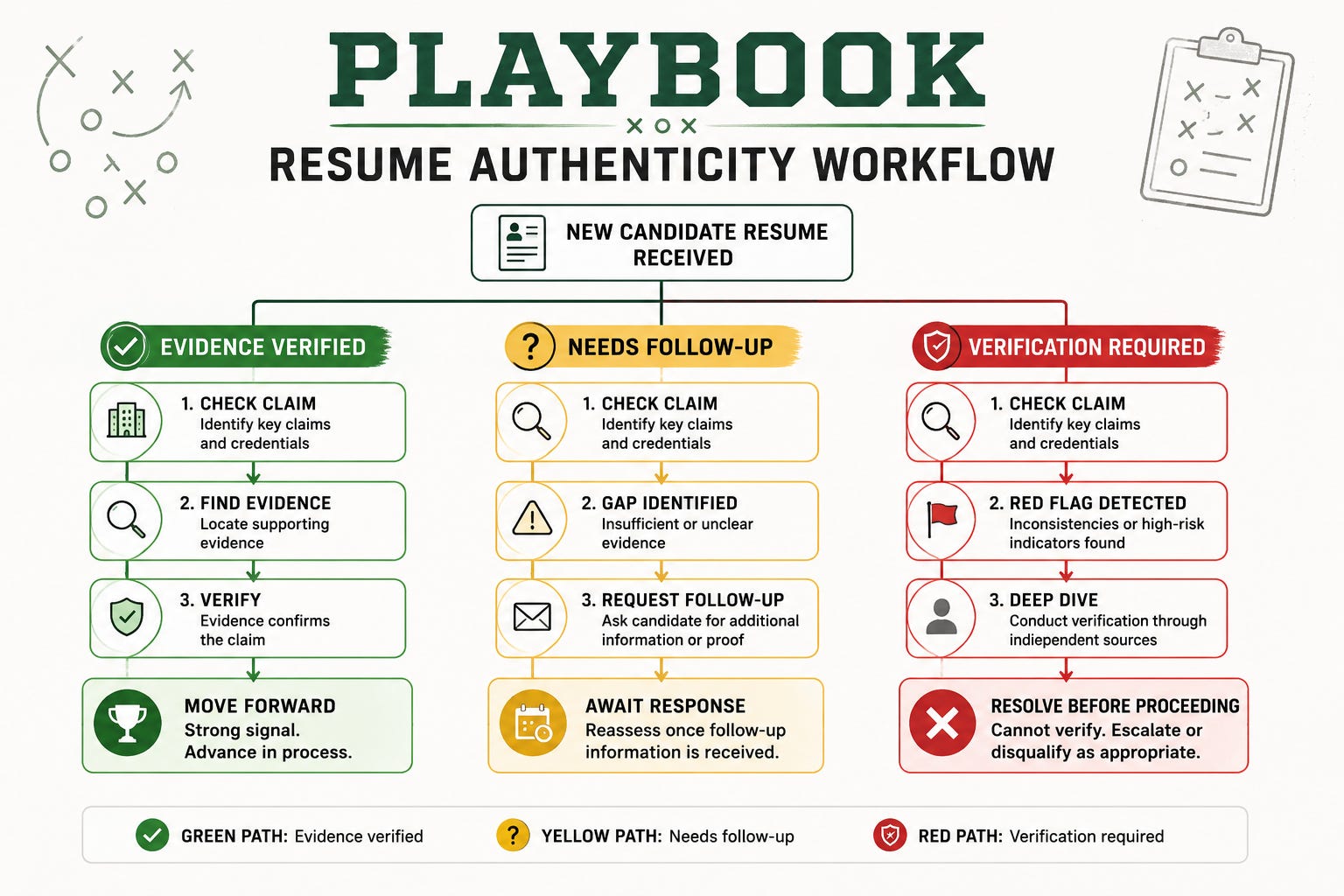
Playbook: Detect and Filter AI-Generated Applications
Goal: Reduce fake, inflated, or low-signal submissions without creating unnecessary friction for legitimate candidates.
Minimum Setup
Your ATS application builder (or Greenhouse, Lever, Workday form builder)
A simple scoring rubric (spreadsheet or ATS custom field)
Optional: OpenAI, Claude, or Gemini access for the prompt-chain step
Calendar tool for 5-minute verification calls
Setup Steps
Add 1–2 evidence prompts to the application. Example: “Describe one project where you used [key tool]. What was your exact contribution, and what was the measurable result?”
Create structured fields for dates, team size, scope, and tools for each major role. This makes inconsistencies easier to spot than free-text resumes.
Build a red-flag scorecard with 5 categories: generic phrasing, inflated titles, missing metrics, improbable skill breadth, and formatting uniformity.
Define a threshold for “verification required” (e.g., 3+ red flags or any single critical claim that cannot be verified online).
Document a candidate-facing policy: “AI tools are welcome for grammar and formatting. All content must be true and your own.”
Evidence Collection Prompts
Evidence prompt: “Pick one relevant project. State the problem, your specific action, the tools, and the outcome with numbers.”
Phone screen opener: “I saw on your resume you led a $2M cost-reduction project. Walk me through the first two weeks.”
Manager note: “If a resume looks perfect but the candidate cannot expand on a single bullet in two minutes, flag it.”
Example Workflow
Application arrives. ATS parses structured fields + resume.
Recruiter runs red-flag screener (prompt chain or manual rubric).
If score <= 2 red flags: move to standard review.
If score >= 3 red flags: send async verification prompt or schedule 5-min call.
Document decision and reason in ATS for audit trail.
Common Mistakes
Rejecting candidates solely because an AI detector flagged the resume. Detectors have high false-positive rates.
Adding so many application questions that completion rates collapse. Keep evidence prompts to 1–2 max.
Forgetting to train hiring managers on the new policy. Managers will revert to old habits if they are not briefed.
Punishing polish. A well-written resume from a legitimate candidate is not the enemy. Focus on verification, not aesthetics.
What Good Looks Like
You have a documented policy, a 2-minute recruiter scoring habit, a structured evidence prompt in the application, and a clean audit trail in the ATS. Your time-to-fill does not increase because you are catching problems early instead of late.
Prompt Chain: Resume Red-Flag Screener
Use case: A recruiter pastes a candidate’s resume into an LLM and receives a structured risk report with follow-up questions, not just a summary.
System prompt
You are a senior recruiting operations analyst. Your job is to read a resume, extract verifiable facts, and flag signals that suggest AI-generated inflation or misrepresentation. Be skeptical but fair. Do not reject a candidate for polish. Flag for verification when claims cannot be substantiated. Output in structured bullets.User prompt sequence
Step 1 - Summarize:
Summarize this resume in 5 bullets. For each bullet, include scope, seniority level, tools used, and a quantified impact claim if present.Step 2 - Flag:
Identify any claims that are vague, duplicated, overly generic, or unusually broad for the tenure shown. List each issue with the exact resume text and a short explanation.Step 3 - Questions:
List 5 follow-up questions that would verify the candidate’s ownership, judgment, and technical depth. Make each question specific to claims in the resume.Step 4 - Score:
Score the resume on a 1–5 risk scale for AI-generated inflation. 1 = fully believable, 5 = high suspicion. Explain the score using only evidence from the resume text.Step 5 - Output:
Rewrite the screening notes into a recruiter-ready summary. Separate: Verified Facts, Open Questions, Red Flags, and Recommended Next Step.Expected outputs
A 5-bullet resume summary with scope, tools, and impact.
A list of red flags tied to exact resume language.
5 specific behavioral or technical follow-up questions.
A 1–5 risk score with justification.
A recruiter-ready summary with clear next-step recommendation.
Adaptation notes
For healthcare/clinician roles, add a prompt about licensure, certification dates, and patient-volume metrics. For campus hiring, add a prompt about capstone projects, team size, and advisor contact. For executive roles, weight “breadth vs. depth” more heavily and add board/advisory verification prompts.
New Tool / Capability Radar
TEST
Ashby AI Agents + Assistant + MCP Support
What changed: Ashby now ships AI agents that can execute sourcing, outreach, and scheduling workflows inside the ATS, plus an AI Assistant and multi-channel publishing support.
What it enables: End-to-end actionability inside the ATS, reducing reliance on separate sourcing CRMs for many use cases.
Recruiting application: Tech recruiting and competitive talent mapping where speed matters.
Recommendation: TEST - If you are an Ashby customer or evaluating ATS switches, run a 2–3 week pilot on one hard-to-fill requisition.
LinkedIn Hiring Assistant + Workday/Paradox Integration
What changed: AI shortlists pushed directly into ATS via Recruiter System Connect, plus Apply Connect x Workday and Paradox conversational scheduling.
What it enables: Compressed apply-to-interview time with less recruiter hand-holding.
Recruiting application: High-volume or hard-to-fill roles where manager self-service unlocks speed.
Recommendation: TEST - If your ATS supports RSC and you use Workday or Paradox, pilot on one hiring manager for 2 weeks.
WATCH
Yello AI Campus Recruiting Agent
What changed: Conversational AI agent for campus events, sourcing, campaigns, and scheduling via SMS/WhatsApp.
What it enables: High-volume early-career operations with less manual event coordination.
Recruiting application: Graduate nurse, intern, or campus engineering programs.
Recommendation: WATCH - If you run campus recruiting, schedule a demo this quarter but do not commit until a peer reference confirms ROI.
ADOPT
SmartRecruiters Winston Companion + Compliance Dashboard
What changed: Deeper candidate ranking, inclusion scoring for JDs, AI-driven scheduling, plus MFA and a compliance dashboard.
What it enables: Faster scheduling and safer global compliance in one release.
Recruiting application: Global tech or healthcare recruiting with strict compliance and DEI requirements.
Recommendation: ADOPT - If already a SmartRecruiters customer, enable inclusion scoring and MFA this month. Evaluate Winston Companion for scheduling next.
Fast Wins
Add one evidence prompt to every open requisition today. “Describe one project, your exact contribution, the tools used, and the measurable result.”
Update recruiter scorecards to include a “verified facts” column.
Create a 5-question phone screen for suspiciously polished resumes.
Publish a candidate-facing AI-use policy - one paragraph on your careers page.
Flag roles with unusually high application volume for manual spot checks this week.
This Week’s Challenge
Pick one requisition and add an evidence-based application question.
Strategic Experiments
Two-week A/B test: standard screening vs. evidence-based prompts. Measure completion rate, recruiter time per app, and first-interview pass rate. Expected outcome: slightly lower completion, much higher pass rate, net time savings.
Build a recruiter copilot (prompt chain or lightweight tool) that extracts facts, flags inconsistencies, and drafts follow-up questions from resumes. Run it against your last 20 hires to benchmark accuracy. Success metric: 80%+ agreement between recruiter and copilot-generated verification questions.
Pilot an authenticity workflow for campus hiring that pairs structured applications with short verification interviews. Track yield and candidate satisfaction.
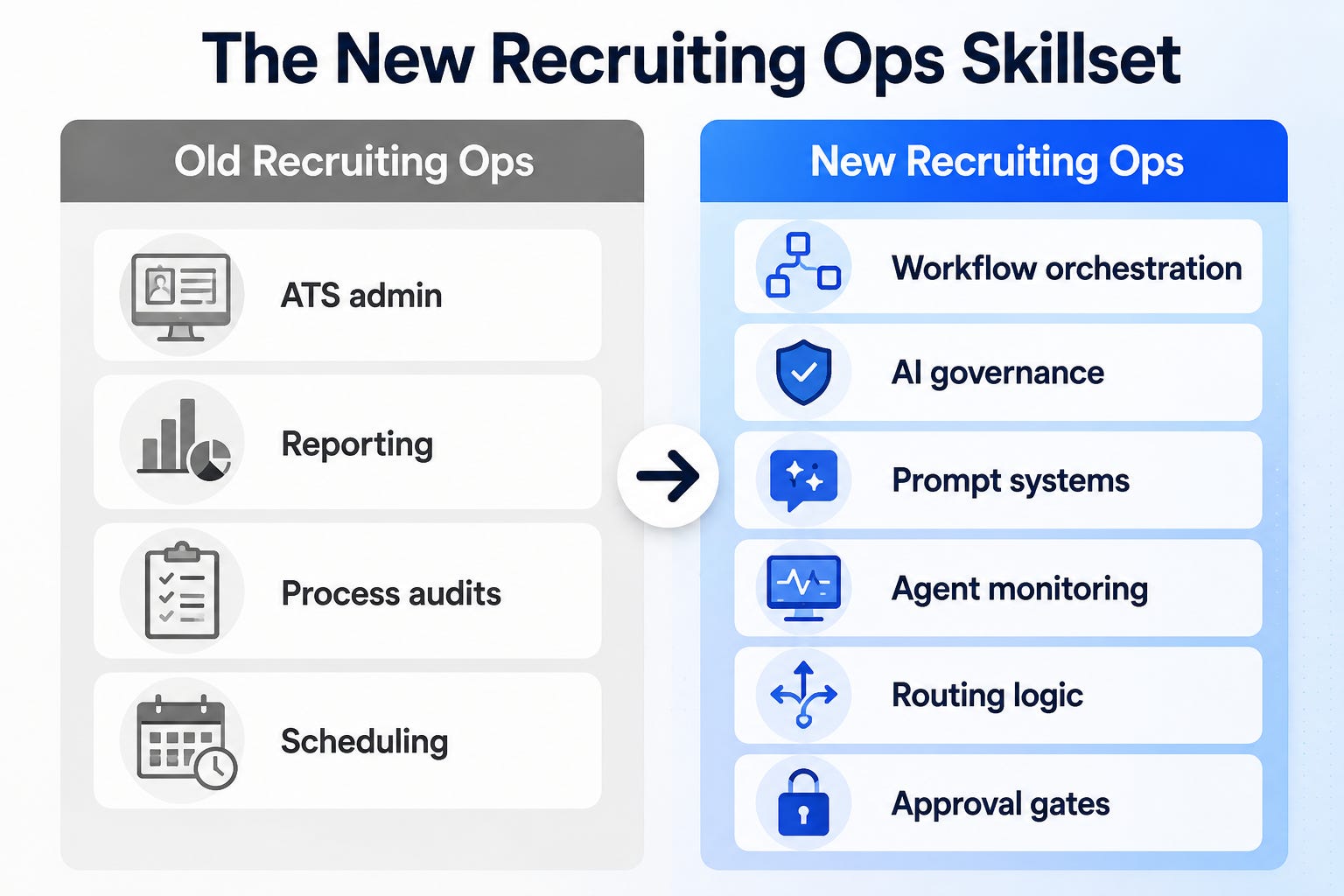
Every recruiting AI workflow will eventually need:
traceability
approval logic
evidence standards
permission controls
human accountability
The next generation of recruiting systems will not be defined by who automates first.
They will be defined by who verifies best. Trust is becoming a competitive advantage.
If your team is experimenting with recruiting agents, workflow automation, or AI routing systems, reply with the biggest candidate verification challenge your team is facing today. I may use the best examples in a future issue.