

AI didn’t break recruiting. Lack of operational discipline did.
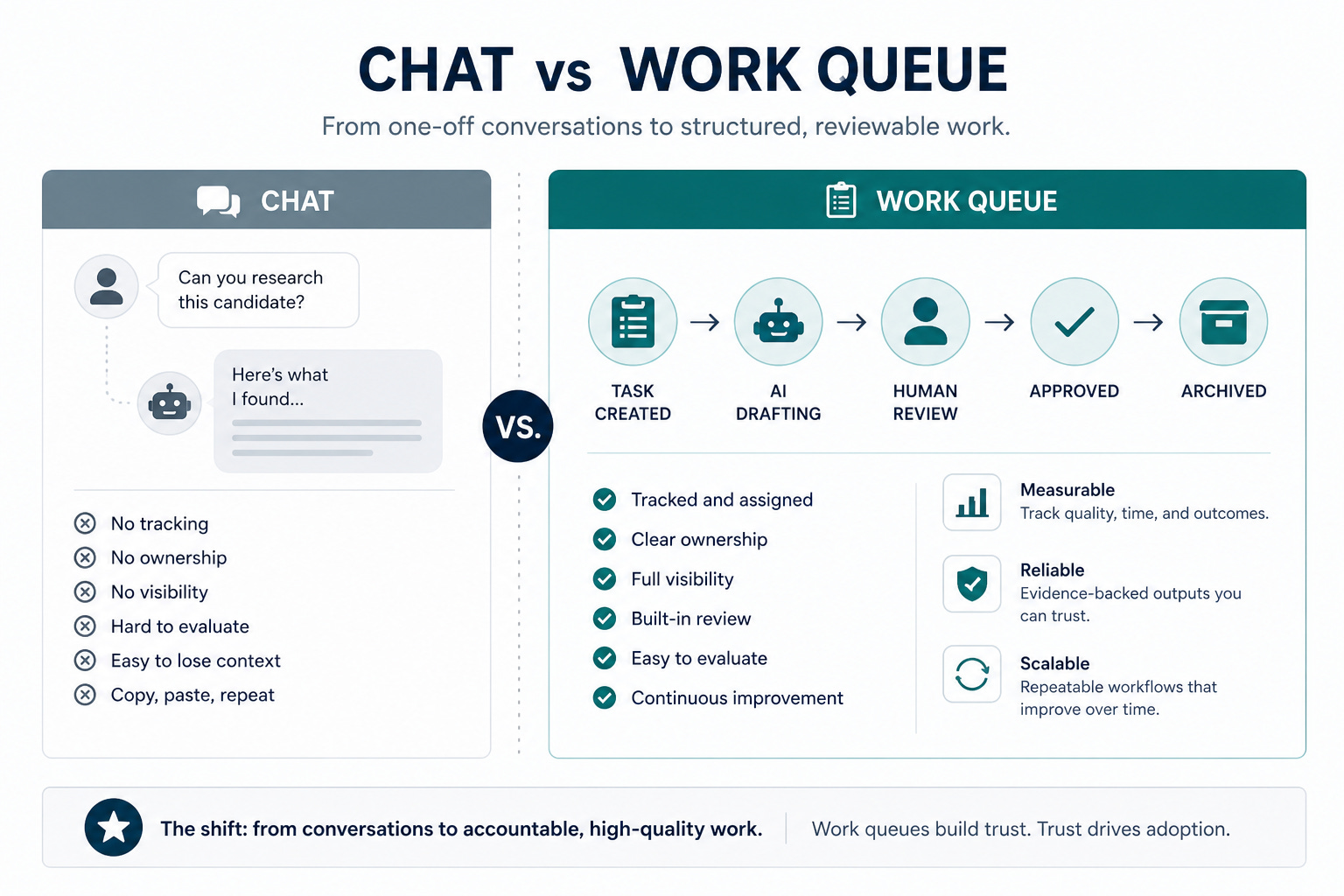
Most teams use AI like a side conversation: paste something in, get something back, move on. That works. It doesn’t scale.
AI work is becoming managed work. Assigned. Tracked. Evaluated. Reviewed.
That shift matters because recruiting needs cleaner execution:
Cleaner intake packets
Stronger sourcing research
Clearer hiring-manager updates
Evidence-backed summaries
Fewer unsupported claims
Don’t chase autonomous recruiting. Build a disciplined recruiting workbench first.
2-Minute Skim
3 things to know
AI is moving from chat sessions to managed work queues
Output is easy. Trust and evaluation are hard
Treat AI like junior operational capacity, not a decision-maker
2 things to test
Build a one-role recruiting workbench with tracked AI tasks
Create an evaluation set before changing models or prompts
1 thing to ignore
Claims that autonomous agents can run recruiting end-to-end
Executive Brief
What changed this week
Agent infrastructure is getting real
Control planes are emerging
Evaluation is becoming the bottleneck
File generation is closing the loop into real work
What teams get wrong
They learn about agents and jump to autonomy. That’s backwards.
What to do instead
Design tighter work:
Specific tasks
Known inputs
Defined outputs
Human review
Evaluation loop
Start with one role. Expand only after it beats your current process.
If you can’t evaluate the workflow, you’re not improving it.
What Matters Most This Week
1. Agent work needs a task board
OpenAI’s Symphony reframes agents as work units on a board. Tasks get assigned. Agents execute. Humans review.
Recruiting translation:
Run sourcing research, outreach drafts, interview prep, and hiring-manager updates as tracked tasks.
The future isn’t “AI assistants.” It’s work queues with receipts.
👉 Takeaway: Treat AI work like tracked work, not prompts.
Source: OpenAI, “An open-source spec for Codex orchestration: Symphony.”
2. Agent sprawl is a governance problem
Microsoft Agent 365 signals what’s coming: centralized control, observability, and security across tools.
Unmanaged AI in recruiting isn’t scrappy. It’s untracked candidate data movement.
👉 Takeaway: If you can’t see it, you can’t control it.
Source: Microsoft Security Blog, “Microsoft Agent 365, now generally available, expands capabilities and integrations.”
3. Evaluation is becoming the bottleneck
Hugging Face shows agent evals are expensive and noisy.
Without a fixed test set, you’re guessing.
👉 Takeaway: If you can’t evaluate the workflow, you’re not improving it.
Source: Hugging Face, “AI evals are becoming the new compute bottleneck.”
4. Model swaps break performance
Same agent. Different model. Different outcome.
LangChain shows 10–20 point swings depending on model tuning.
👉 Takeaway: Treat model upgrades like workflow changes.
Source: LangChain, “Tuning Deep Agents to Work Well with Different Models.”
5. File generation is real leverage
Gemini can now generate structured artifacts directly.
Less copy/paste. More usable output.
This is where recruiting ops wins time.
👉 Takeaway: The biggest gains look boring - and they compound.
Source: Google, “You can now easily generate files in Gemini.”
6. Document agents must preserve evidence
Agents are getting better at handling real files.
That’s useful only if they preserve traceability.
The moment an agent gives a verdict instead of evidence, it has crossed the line.
👉 Takeaway: No evidence, no trust.
Source: LlamaIndex, “LlamaParse MCP: Agentic OCR tools for your AI agents.”
7. Persistent agents change the workflow
Mistral’s remote agents show the pattern:
Long-running work. Visible actions. Approval gates.
👉 Takeaway: If it can’t show its work, it shouldn’t touch recruiting.
Source: Mistral AI, “Remote agents in Vibe. Powered by Mistral Medium 3.5.”
Playbook: Build a Recruiting Agent Workbench
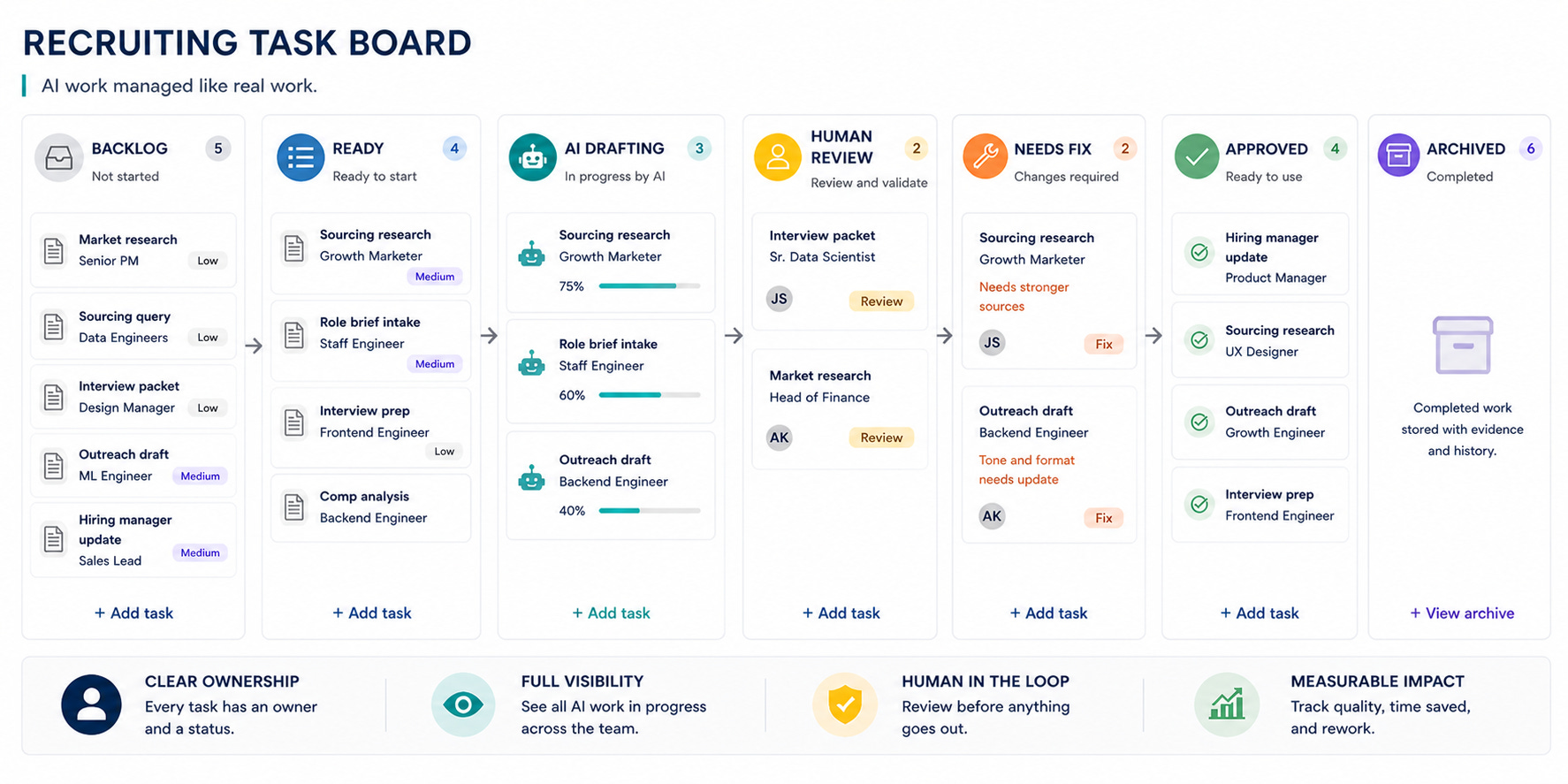
This is what operational AI in recruiting actually looks like.
Goal:
Turn AI from scattered prompts into a managed workflow for one role.
Setup
Pick one active role with real volume
Define 5 AI-supported tasks:
Market research
Sourcing queries
Outreach drafts
Interview packets
Hiring-manager updates
Define 3 tasks AI cannot do:
Reject candidates
Rank final slates
Infer protected traits
Create a task board:
Backlog → Ready → AI Drafting → Human Review → Needs Fix → Approved → Archived
Assign an owner and a reviewer
Workflow
Write a one-page role brief
Create reusable task templates
Add 5 real tasks
Run AI against defined prompts
Save outputs as review packets
Score:
Accuracy
Usefulness
Evidence quality
Rework
Approve only after human review
Update prompts based on failure patterns
Review weekly
Prompt:
You are supporting recruiting operations for one role.

Rules:

- Do not make hiring decisions
- Do not rank candidates without explicit criteria
- Cite evidence for every claim
- Flag uncertainty
- Produce a reviewable output

Role brief:
[paste role brief]

Task type:
[market research / sourcing query ideas / outreach draft / interview packet / hiring-manager update]

Inputs:
[paste sanitized inputs]

Output format:
[define exact format]
Common Mistakes
Letting AI infer criteria from vague job descriptions
Asking for recommendations instead of evidence
Sending AI outreach without validation
Changing tools without re-evaluation
What Good Looks Like
Every task has an owner, inputs, and status
Outputs cite evidence and uncertainty
Recruiters can explain what AI did
Hiring managers get cleaner artifacts, not more noise
Prompt Chain: Evidence-Based Candidate Packet
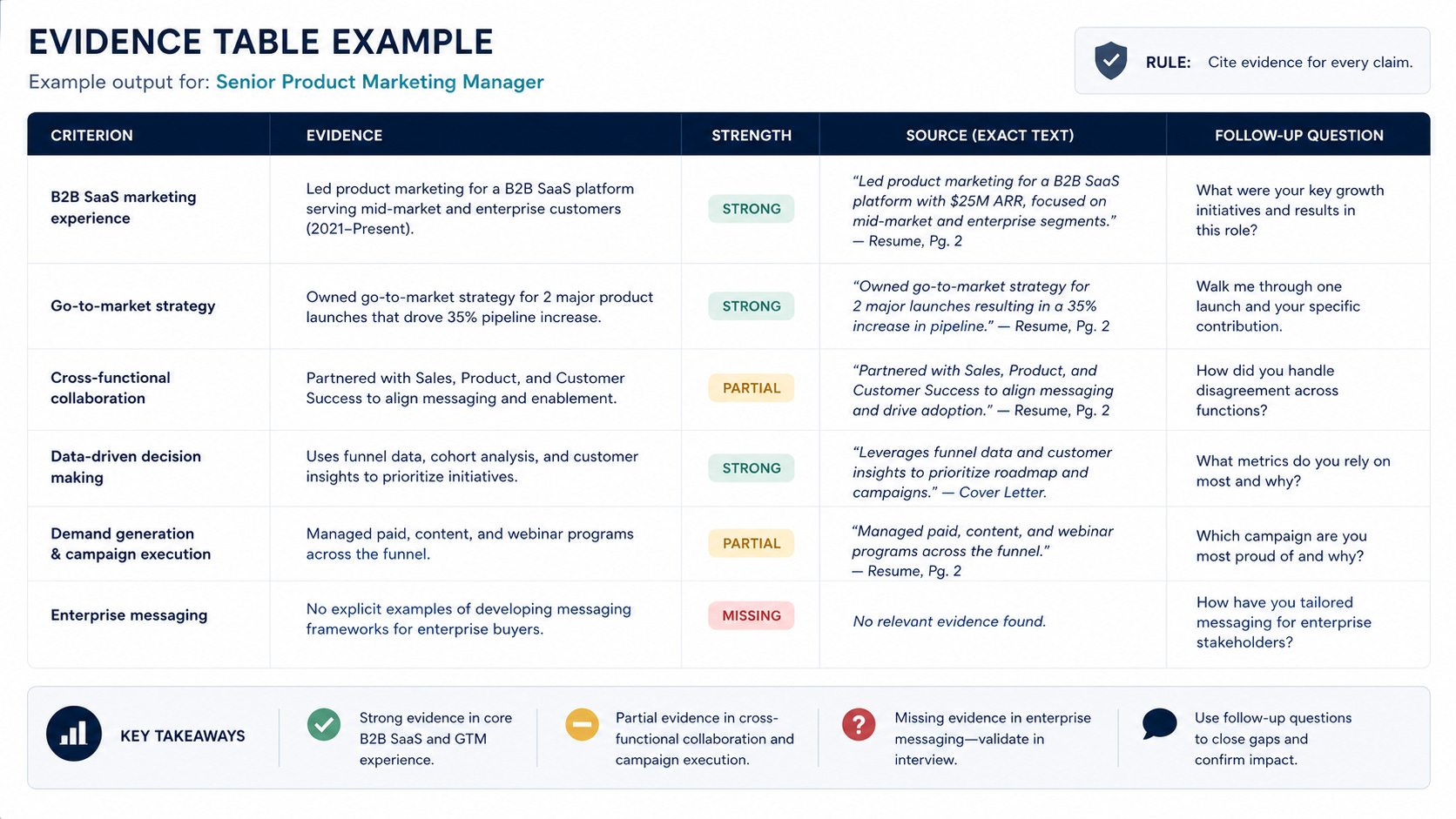
This is how you force AI output to stay reviewable.
Use this to convert sanitized candidate materials into a recruiter-reviewed packet tied to role criteria.
System prompt:
You are a recruiting operations assistant. You organize candidate evidence for human review.

You must not decide whether to advance or reject a candidate. You must not infer protected traits, personality, culture fit, age, health, nationality, race, gender, disability, or family status. You must cite evidence from the provided materials and flag missing information clearly.
Prompt 1:
Extract evidence.

Role criteria:
[paste must-have and nice-to-have criteria]

Candidate materials:
[paste sanitized resume, notes, portfolio excerpts, or transcript excerpts]

Return a table with:
- Criterion
- Evidence found
- Evidence strength: Strong / Partial / Missing
- Source text
- Follow-up question for human interviewer
Prompt 2:
Using only the evidence table, list:
- Unsupported claims that should be removed
- Criteria with missing evidence
- Questions a recruiter should ask before presenting the candidate
- Any places where the input could bias the reviewer
Prompt 3:
Create a concise candidate packet for human review:
- Candidate snapshot
- Evidence by must-have criterion
- Open questions
- Suggested interview focus areas
- Do not include a recommendation to advance or reject
When this breaks: the criteria are vague, the resume is too thin, the model invents judgment language, or the team uses the packet as a decision instead of a review artifact.
Fast Wins
Build a simple AI workflow inventory
Turn one update into a reusable template
Create a 20-case evaluation sheet
Add “Reviewed by [owner]” to outputs
Publish a “do not use AI for” list
Strategic Experiments
Recruiting Agent Workbench
Hypothesis:
Task-based AI reduces admin time without lowering quality.
Test:
Run 20 AI-supported tasks with review.
Measure:
Time saved, rework, usefulness, errors, confidence.
Evaluation Set
Hypothesis:
A fixed test set catches regressions.
Test:
Compare prompts and models on the same cases.
Measure:
Accuracy, missing data, tone, pass rate.
AI Artifact Packaging Sprint
Hypothesis:
File generation beats sourcing automation for time savings.
Test:
Convert reporting and docs into AI templates.
Measure:
Prep time, rework, adoption.
The Shift Is Happening
Recruiting is moving from intuition and effort to systems and evidence.
The teams that win won’t be the ones using the most AI tools. They’ll be the ones who operationalize them.
Work queues. Review loops. Evaluation sets. Clear ownership.
That’s the difference between “AI-assisted recruiting” and a recruiting function that actually scales.
What You’ll Get Here
If this resonates, this is what I’ll keep breaking down:
Practical AI workflows you can implement
Real recruiting systems
Playbooks that improve speed, quality, and trust
Clear guidance on what to ignore
No hype. No generic advice. Just what works.
Subscribe if You’re Building
If you’re building, fixing, or scaling a recruiting function, this is for you.
Subscribe to get the next issue.