

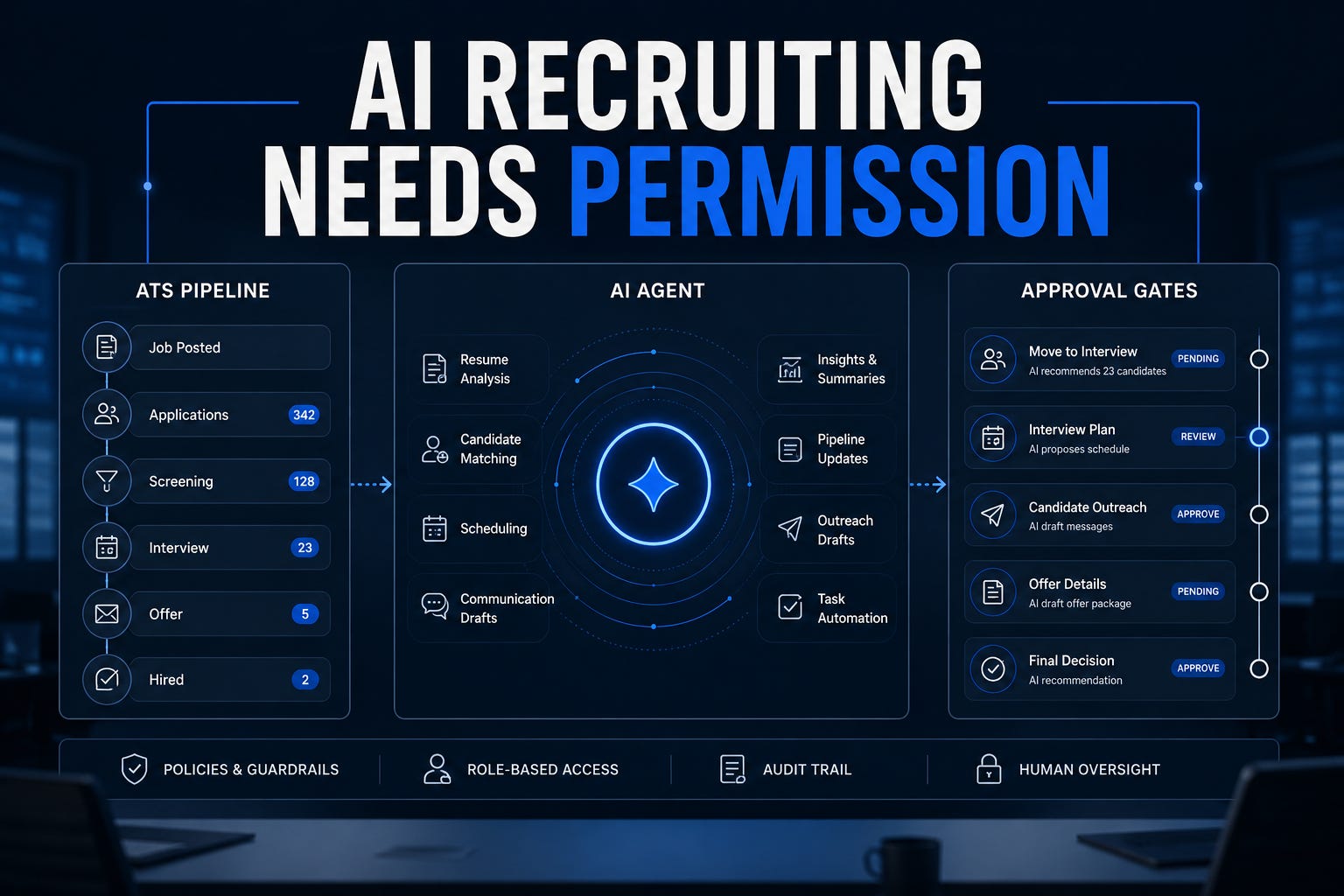
An AI assistant with ATS write access is a new operator in your hiring system.
Workable announced MCP access for recruiting and HR workflows. Google published a long-running HR onboarding agent pattern. GitHub added team-level AI usage metrics. OpenAI made Codex easier to supervise from mobile.
Recruiting AI is moving from chat interfaces into systems of record. The teams that win will be the ones that define authority, approvals, evidence standards, and auditability before agents touch production workflows.
2-Minute Skim
3 things to know
Recruiting AI is moving from chat windows into systems of record.
Long-running agents are becoming practical for workflows like onboarding, offer coordination, and background-check follow-up.
AI interviewing is accelerating faster than trust, validation, and compliance.
2 things to test
Build a permissioned workflow map for one role: systems touched, write actions allowed, approval gates, logs, and failure modes.
Run a team-level AI adoption review if your engineering, people systems, or recruiting ops teams use GitHub Copilot or similar tools.
1 thing to ignore
Claims that AI interviewers are ready because they are rubric-based or adaptive. Rubrics help, but they do not prove fairness, validity, candidate trust, or legal defensibility.
Executive Brief
AI agents crossed from experimentation into operational workflows. Google published a concrete long-running HR onboarding agent architecture. Workable announced MCP access for recruiting and HR workflows. GitHub added team-level Copilot usage metrics and more cloud-agent automation. OpenAI pushed Codex into mobile supervision with enterprise controls.
Many teams will connect agents to ATS/HCM data before defining authority. The hard part is defining authority, evidence standards, approval logic, and failure handling.
Recruiting practitioners should pick one recruiting workflow with clear steps and build the control model first. Define states, data permissions, human approvals, source citations, logs, and rollback paths. Then automate the repeatable coordination work.
What Matters This Week
1. ATS-native agent access is here.
An AI assistant with ATS write access is a new operator in your hiring system.
Workable’s MCP server gives compatible assistants permission-scoped access to recruiting and HR objects. This is the bridge from AI summaries to AI actions inside hiring systems.
Recruiting use case: Ask an assistant to pull pipeline status, draft follow-ups, update stages, or prepare requisition summaries from live ATS data.
👉 Takeaway: Do not enable read/write AI access until permissions, audit logs, test users, and blocked actions are documented.
Source: Workable / GlobeNewswire, May 13, 2026
2. Long-running recruiting agents need state machines.
Google’s ADK tutorial shows an HR onboarding agent that pauses for signatures, resumes on webhooks, delegates IT provisioning, and persists state.
Recruiting use case: Automate offer/onboarding coordination across signed documents, background checks, equipment, start-date changes, and hiring-manager reminders.
👉 Takeaway: Model the workflow as states first: waiting, approved, blocked, completed, escalated. If your agent has no explicit state, it will invent progress. That is unacceptable in hiring operations.
Source: Google Developers Blog, May 12, 2026
3. AI adoption data is becoming a workforce signal.
GitHub’s team-level Copilot metrics API lets admins aggregate usage by team, feature, language, IDE, and model. For talent leaders, this is a practical enablement signal.
Recruiting use case: Identify engineering teams that need AI workflow coaching, not to rank individual engineers.
👉 Takeaway: Track adoption, workflow coverage, and review quality by team; avoid simplistic productivity claims. Usage is not value. A team using Copilot more may be better enabled, more experimental, or just doing noisier work.
Source: GitHub Changelog, May 14, 2026
4. Agent supervision is going mobile.
OpenAI put Codex in ChatGPT mobile preview and added Remote SSH GA, hooks GA, and enterprise programmatic tokens. The shift is asynchronous agent supervision: review, approve, redirect, and unblock from anywhere.
Recruiting use case: Recruiting ops or people-systems owners can monitor internal automation, approve safe changes, and review outputs without being chained to a desktop.
👉 Takeaway: Design AI workflows around decision points, not continuous human babysitting. Mobile agent control is useful only when the approval gates are clean. Otherwise it becomes Slack, but riskier.
Source: OpenAI, May 14, 2026
5. Compliance is moving to operational records.
Colorado’s revised AI law targets automated decision tools in consequential HR decisions, including hiring and compensation. The practical requirement is inventory, disclosure, human review, and records.
Recruiting use case: Map where AI materially influences screening, ranking, interview scoring, compensation, or rejection decisions.
👉 Takeaway: Start the AI hiring tool inventory now, even if enforcement is not immediate. If you cannot list where AI affects candidates, you are already behind.
Related: I wrote about this exact problem in “If You Cannot Audit AI Hiring, Do Not Scale It” - including how to build traceability, review checkpoints, and evidence standards into recruiting workflows.
Source: HR Dive, May 15, 2026
6. Application volume is now an operating problem.
HR Dive, citing Ashby data, reports applications per hire have tripled since 2021 and roles now average 300+ applications. The issue is signal extraction, response discipline, and funnel design.
Recruiting use case: Redesign top-of-funnel workflows around structured knockout criteria, candidate comms, and review capacity.
👉 Takeaway: Use AI to reduce noise, not to hide behind automated rejection. More applicants doesn’t mean more talent. They mean your process needs sharper gates and better communication.
Source: HR Dive, May 13, 2026
Playbook: Build a Permissioned Recruiting Agent Workflow
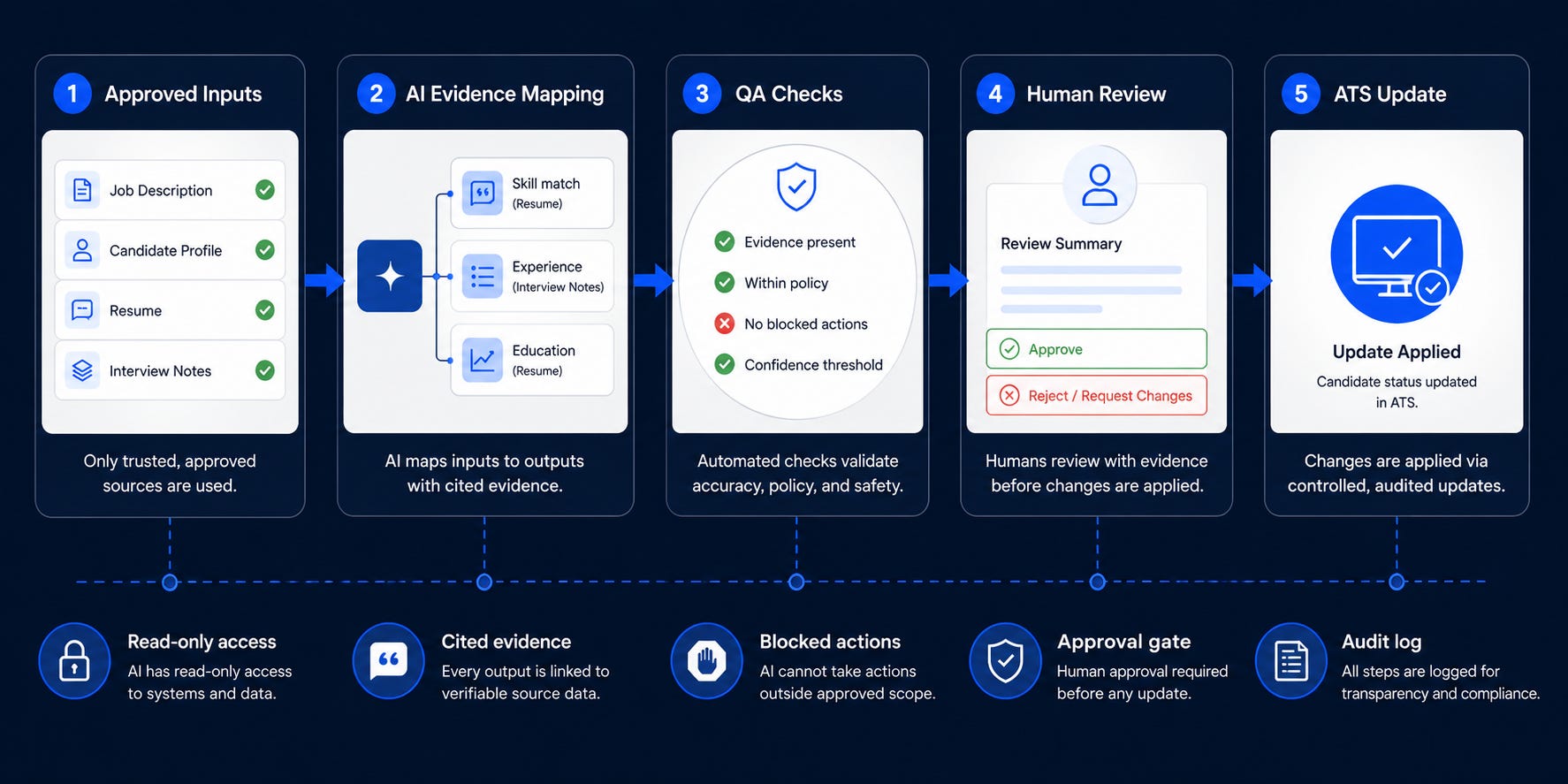
Use this for candidate intake-to-shortlist support on one high-volume role. The goal is faster evidence packaging with clear human decision ownership.
Setup
Select one role with high volume and clear criteria.
Define allowed data: job description, intake notes, candidate resumes, applications, recruiter notes, approved rubric.
Define blocked data: protected characteristics, social media inferences, compensation history where prohibited, unverified scraped data.
Define allowed actions: summarize evidence, identify missing information, draft recruiter review packets, draft candidate updates for human approval.
Define blocked actions: reject candidates, rank candidates without rubric evidence, update ATS stages, send messages, infer protected traits, make compensation recommendations.
Define review gates: recruiter review before shortlist, hiring-manager review before interview, compliance review for any scoring automation.
Prompt
You are a recruiting operations assistant. Your job is to package evidence for human review, not make hiring decisions. Use only the approved job description, intake notes, scorecard, and candidate-provided materials. Do not infer protected characteristics. Do not recommend rejection. Every claim must cite the source field or document. If evidence is missing, say so.

Role: [role]
Approved criteria: [paste scorecard]
Candidate packet: [paste/export]

Create a recruiter review packet with:
1. Evidence mapped to each criterion
2. Missing or ambiguous evidence
3. Questions for recruiter follow-up
4. Risks or inconsistencies to verify
5. A concise candidate summary using only cited evidence

Do not rank, reject, or make a hiring recommendation.
Workflow
Export 10 recent candidate packets from one role.
Run the prompt against each packet.
Have a recruiter compare AI packets against manual review.
Track unsupported claims, missed evidence, overconfident language, bias risk, and missing citations.
Revise the scorecard and prompt until outputs are boring, cited, and consistent.
Only then connect to live ATS data or automate packet creation.
Common mistakes
Starting with ATS write access instead of read-only evidence packaging.
Asking the model to rank candidates before the rubric is clean.
Treating citations as optional.
Letting AI create new criteria that were not approved during intake.
Measuring speed while ignoring error rates and candidate impact.
When NOT to use this
The role has vague criteria.
The hiring manager has not agreed to the scorecard.
Candidate data includes sensitive information you cannot safely control.
You cannot audit outputs.
Recruiters plan to rubber-stamp AI recommendations.
Expected outcomes
20-40% faster recruiter packet preparation after calibration.
Better hiring-manager alignment because evidence is mapped to approved criteria.
Fewer unsupported claims in candidate summaries.
Clearer audit trail if challenged.
Prompt Chain: Candidate Evidence Packet QA
System prompt:
You are an AI recruiting quality-control assistant. You help recruiters evaluate whether candidate review packets are evidence-based, structured, and fair. You do not make hiring decisions. You identify unsupported claims, missing evidence, vague criteria, and places where human review is required.
Prompt 1:
Turn this intake note and job description into 5-7 observable evaluation criteria. Use plain language. Do not add criteria that are not present in the source material. Flag anything vague or subjective.
Prompt 2:
Using only the candidate packet, map evidence to each criterion. Include direct source references. If evidence is missing, write "No clear evidence found." Do not infer.
Prompt 3:
Audit this review packet. Identify unsupported claims, missing citations, subjective language, criteria drift, and any recommendation that exceeds the evidence. Rewrite the packet so it is evidence-based and decision-neutral.
Prompt 4:
Draft 3-5 recruiter follow-up questions that would resolve the biggest evidence gaps. Keep them job-related, structured, and candidate-friendly.
This breaks when the intake is vague, the scorecard is not approved, candidate materials are thin, or recruiters ask the model for recommendations instead of evidence.
Tool / Capability Radar
Watch
AI interview scoring → Don’t scale without validation
Browser/source agents → Prompt injection risk is real
Test
ATS MCP access → High leverage, high governance risk
Team AI metrics → Useful signal, weak productivity proxy
Agent middleware → Approval hooks beat prompt rules
Adopt
Long-running HR agents → Use state machines before automation
Fast Wins
Run a 45-minute AI hiring tool inventory: tool, owner, data touched, decision influence, human review, vendor contract.
Add a required citation field to every AI-generated candidate summary.
Create a blocked-actions list for recruiting AI: reject, rank, send, update stage, infer protected traits, recommend pay.
Test one evidence-packet prompt on 10 candidates and track unsupported claims.
Ask IT for a list of AI tools with access to ATS, HRIS, email, calendar, or candidate files.
Strategic Experiments
Permissioned candidate packet assistant
Hypothesis: Recruiters can prepare higher-quality review packets faster if AI maps evidence to criteria but cannot recommend decisions.
Test: Run 25 historical candidates through the workflow and compare to prior recruiter notes.
Measure: Time saved, unsupported claims, missed evidence, recruiter satisfaction, hiring-manager usefulness.
Long-running offer/onboarding coordinator
Hypothesis: A state-machine agent can reduce coordination misses in offer-to-start workflows without taking over decisions.
Test: Model one workflow with states for offer sent, accepted, background check, equipment, start-date confirmation, first-day packet.
Measure: Delayed handoffs, missed reminders, cycle time, candidate experience feedback.
AI adoption enablement by team
Hypothesis: Team-level AI usage data helps target training better than broad enablement sessions.
Test: Compare Copilot usage patterns with self-reported workflow blockers across engineering or recruiting ops teams.
Measure: Active usage, review quality, cycle time for low-risk tasks, manager confidence.
Every AI recruiting workflow will eventually need:
traceability
approval logic
evidence standards
permission controls
human accountability
The next generation of recruiting systems will be defined by who governs it best.
If you’re designing recruiting workflows with AI agents, approvals, or ATS integrations, reply with the biggest governance problem you are trying to solve. I may build future breakdowns around the best examples.