

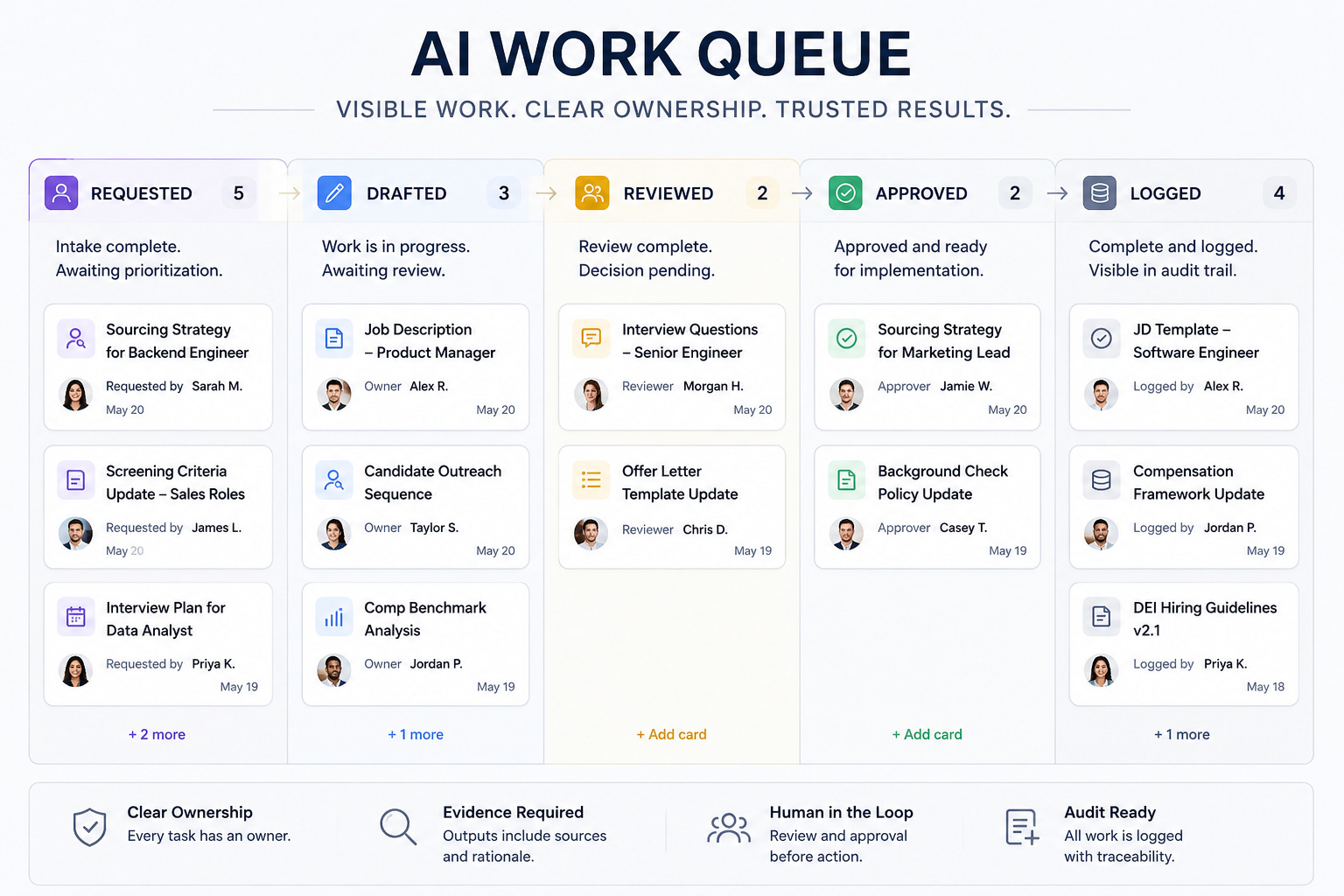
Everyone is focused on what AI agents can do, but few teams are asking how AI work should be managed. This week brought another wave of agent announcements from GitHub, Microsoft, AWS, OpenAI, Anthropic, and Greenhouse. Most coverage focused on capabilities, but the more important signal is operational.
AI work is easier to launch, trigger, and connect to enterprise systems. Recruiting leaders should spend less time thinking about prompts and more time thinking about governance. If AI is doing recruiting work, it needs a queue, an owner, a reviewer, evidence, and a correction log. Once AI work becomes easy to launch, it becomes easy to hide.
The organizations that get this right will win because they built better systems around it.
2-Minute Skim
3 things to know
Agent work is becoming programmable. AI tasks are increasingly being triggered, tracked, and managed like work tickets.
Enterprise AI is moving into existing work systems. Microsoft, Greenhouse, and others are embedding AI directly into operational workflows.
AI operations now require monitoring, approvals, audit trails, and governance controls similar to any other business-critical system.
2 things to test
Create a recruiting AI task queue for one workflow: owner, task type, evidence required, reviewer, status, and correction reason.
Send AI-generated interview preparation packets to hiring managers and measure usefulness, adoption, and quality.
1 thing to ignore
Claims that larger context windows or autonomous agents automatically make AI ready for end-to-end recruiting decisions. Better retrieval does not eliminate bias, weak criteria, poor judgment, or compliance risk.
Executive Brief
GitHub introduced APIs that allow AI work to be launched and tracked like any other system task. Microsoft expanded AI’s ability to operate inside organizational work graphs. AWS published practical guidance for monitoring AI operations at scale. Greenhouse launched MCP, creating a governed way for AI tools to interact with recruiting workflows and ATS data.
Many organizations will interpret these developments as permission to automate more recruiting activities, but be careful.
The easier it becomes to launch AI work, the more important it becomes to control what work can be launched, who can launch it, what evidence is required, and what level of human review is necessary. Recruiting teams need operating systems for managing AI work.
If you cannot see the AI task, you cannot manage it.
What Matters This Week
1. Greenhouse Turns the ATS Into a Governed AI Platform
Greenhouse launched MCP, creating a governed way to connect AI tools directly to the ATS through permissioned access and audit controls.
Recruiting use case
AI assistants can enrich candidate profiles, update fields, summarize notes, and support recruiter workflows while maintaining visibility into who did what and when.
Takeaway: Map every workflow that currently requires manual copying and pasting between your ATS and another tool. The future is moving toward AI operating through the ATS under controlled permissions.
2. Agent Work Is Becoming Programmable
AI tasks are increasingly being launched, tracked, and managed through APIs instead of individual chat sessions.
Recruiting use case
Candidate packets, intake summaries, interview preparation, status updates, and hiring-manager communications can all move through structured workflows with assigned reviewers.
Takeaway: Treat AI outputs like work items. If you cannot see the AI task, you cannot manage it.
3. AI Is Moving Into Existing Work Systems
Enterprise vendors are embedding AI directly into email, documents, meetings, workflow systems, and operational tools.
Recruiting use case
Recruiter assistants can leverage intake notes, role requirements, interview plans, scorecards, and hiring-manager communications to produce better outputs.
Takeaway: Clean up your recruiting documentation before connecting AI to it. AI connected to messy processes will amplify the mess.
4. AI Operations Need Monitoring
AWS published a detailed architecture showing how organizations should monitor AI usage, cost, anomalies, latency, failures, and operational health.
Recruiting use case
Track AI-generated candidate packets, outreach drafts, interview prep documents, recruiter usage, correction rates, and workflow failures.
Takeaway: Create dashboards before expanding AI usage. If you wouldn’t run a recruiting CRM without reporting, don’t run AI workflows without monitoring.
5. Governance Is Becoming a Leadership Responsibility
As AI gains write access to operational systems, governance moves from IT concern to executive concern.
Recruiting use case
Every recruiting AI tool should have documented permissions, approved actions, blocked actions, escalation paths, and audit logs.
Takeaway: Inventory every recruiting AI tool currently in use. The biggest AI risk is usually not the model. It’s uncontrolled access.
Related: AI Recruiting Needs Permission
Overhyped This Week
Bigger Context Windows
Larger context windows are useful. They help AI process longer documents, interview transcripts, job descriptions, policies, and candidate histories.
But they do not solve:
Bias
Compliance risk
Weak hiring criteria
Poor documentation
Missing evidence
Accountability
If your recruiting process is broken, more context gives AI more broken information to work with.
Playbook of the Week
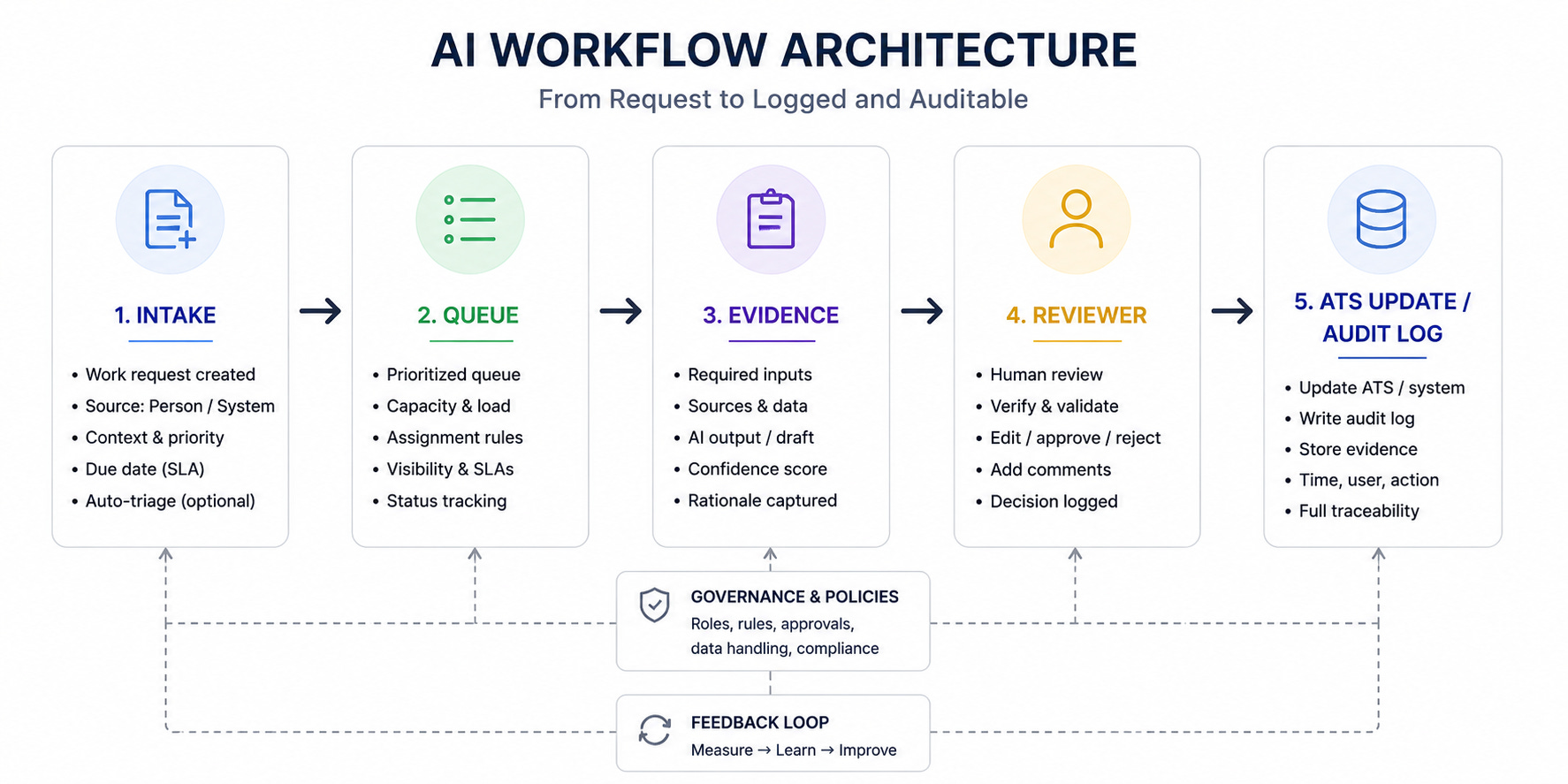
Build a Recruiting AI Task Queue
Use this when recruiters are already using AI for:
Candidate summaries
Outreach drafts
Interview preparation
Hiring-manager updates
Intake-note extraction
Status reporting
Step 1
Choose one workflow only.
Examples:
Candidate packet creation
Interview prep packets
Outreach drafting
Hiring-manager summaries
Step 2
Define AI’s scope.
Allow:
Read
Extract
Summarize
Draft
Do not allow:
Candidate ranking
Rejection decisions
ATS status changes
Candidate communication
Hiring recommendations
Step 3
Create queue fields.
Track:
Request ID
Workflow
Requester
AI tool used
Allowed action
Reviewer
Status
Corrections
Time saved
Risk flag
Step 4
Review every output.
Check for:
Missing evidence
Unsupported claims
Policy violations
Tone issues
Hallucinations
Step 5
Measure correction rate.
Ask: How often does a human need to fix the output?
What good looks like
Every AI output has:
An owner
Source material
Reviewer
Status
Correction history
Nothing reaches a candidate or changes ATS data without human approval.
Prompt of the Week
Recruiting AI Task Queue Prompt
You are a recruiting operations assistant.

You may extract, summarize, and draft.

You may not:

- Rank candidates
- Recommend rejection
- Infer protected characteristics
- Change ATS stages
- Send messages
- Make hiring decisions

Use only the provided source material.

Cite the source for every factual claim.

If evidence is missing, write "Not Evidenced."

Output:

1. Draft Output
2. Evidence Table
3. Missing Evidence
4. Risks or Assumptions
5. Human Review Required
Tool Radar
ADOPT
AI task queues
Correction logs
Evidence-based outputs
Human review workflows
Sensitive-data access reviews
TEST
AI interview preparation packets
AI usage dashboards
Approved connector lists
Manager-facing AI assistants
WATCH
Greenhouse MCP
Microsoft Work IQ
Enterprise-managed AI plugins
OpenAI enterprise deployments
AVOID
AI candidate ranking
Autonomous ATS updates
Unreviewed candidate communications
End-to-end recruiting agents
Fast Wins
Build a simple AI task queue this week.
Add reviewer and correction fields to AI-generated recruiting work.
Create a short blocked-actions policy for every recruiting prompt.
Review vendor contracts for AI data-sharing language.
Ask vendors whether administrators can see every AI action and output.
Create a list of recruiting data that AI should not access by default.
Inventory every AI tool currently touching candidate or employee data.
Strategic Experiments
AI Task Queue Pilot
Hypothesis: Visible AI workflows improve quality and reduce unmanaged AI usage.
Test: Route 50 recruiting tasks through a queue over two weeks.
Measure:
Time saved
Correction rate
Policy violations
Reviewer satisfaction
AI Approval Gate Pilot
Hypothesis: Approval gates reduce hallucinations and compliance risk without eliminating productivity gains.
Test: Require approval before:
Candidate communications
ATS updates
Hiring-manager recommendations
Measure:
Corrections
Escalations
Policy violations
User satisfaction
Sensitive Data Access Review
Hypothesis: Most recruiting AI risk comes from excessive access rather than bad prompts.
Test: Inventory every tool touching:
Resumes
Compensation
Immigration data
Accommodation requests
Employee relations information
Measure:
Excess permissions
Missing audit logs
Undefined retention policies
Lack of human review
Many recruiting leaders are asking: “How much work can AI do?” A better question is: “How much AI work can we responsibly manage?”
The next generation of recruiting teams will be defined by the systems they build around them. Make the work visible. Then make it better. Invisible AI work is unmanaged AI work.
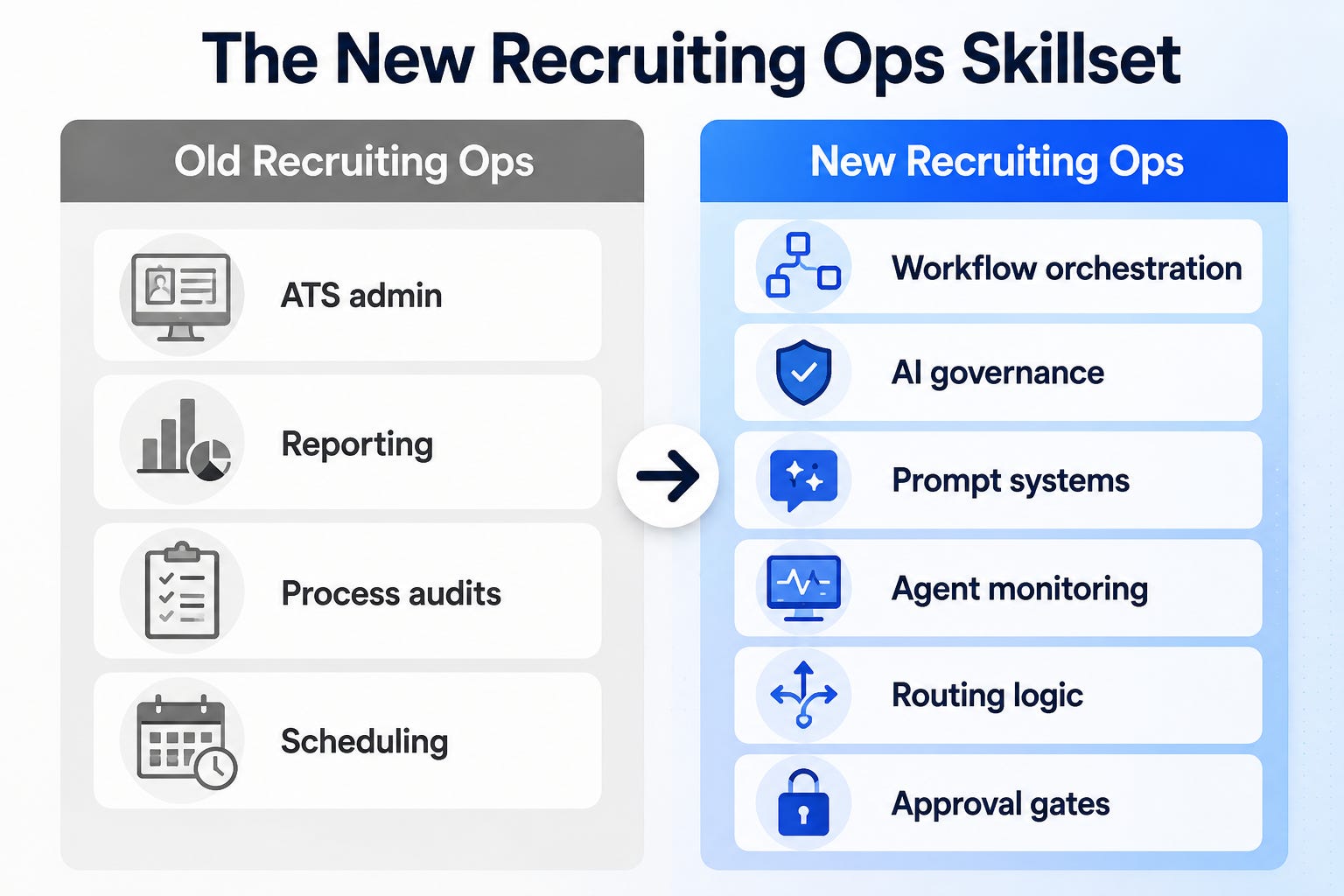
Every recruiting AI workflow will eventually need:
traceability
approval logic
evidence standards
permission controls
human accountability
If your team is experimenting with recruiting agents, workflow automation, or AI routing systems, reply with the biggest AI governance or workflow challenge you’re trying to solve. I may feature the best examples in a future issue.